Teaching Kids About Money: A Parent's Roadmap
We're parents sharing what we've learned, not financial advisors. Some links may pay a referral. Full disclosure.
Michael Saylor graduated top of his class at MIT, took a company public, made hundreds of millions of dollars, and by his own admission didn't understand money until 2020.1 His words: “I legitimately didn't really understand money or inflation until the year 2020.”
He's not unusual. Only 27% of American adults can pass a basic financial literacy quiz.2 MIT didn't teach Saylor what money was. Most schools don't teach your kids either. That job falls to you.
This is your roadmap. It's organized by age, with links to the specific lessons that go deeper on each topic. Think of it as the table of contents for your kid's financial education.
Money is a technology
Before you teach your kid about money, it helps to understand what money actually is. Saylor puts it bluntly: “Money is technology. It always has been technology, whether it was seashells or salt or cattle.”3
Here's the short version. Humans bartered for thousands of years (my fish for your wheat). Then we moved to commodity money: shells, salt, cattle. Around 600 BC, coins showed up in Asia Minor.4 Paper money arrived in China around the 9th century. The gold standard locked currencies to a physical metal through the 1800s and early 1900s. Nixon killed it in 1971. Since then, we've used fiat: money backed by government promises, not physical stuff.
Every few centuries, the money changes. Your kid is growing up during one of those changes. Our history of money for kids guide walks through the full timeline.
Ages 3-5: money is finite
One concept matters at this age: you can't have everything. When the money is gone, it's gone. Don't mention banks, interest rates, or Bitcoin. Just let them hold coins, count them, and spend them until the jar is empty.
Set up a play store at home. Price the snacks. Give them real coins. Let them run out. That's the whole lesson. Research from Cambridge University shows that money habits are largely set by age 7.5 Starting at 3 gives you a 4-year head start on building good ones.
Ages 6-9: what money is, how banks work, saving vs. spending
Now they can handle bigger ideas. This is the age to teach them what money actually is, where it lives, and the difference between spending it now vs. saving it for later.
Key concepts and where to go deeper:
- What happens to your money at a bank. Your kid thinks the bank is a vault. It's not. Banks lend most of your money out and keep a fraction. Our how banks work guide explains it.
- Why prices go up. That candy bar used to cost a quarter. Now it's $2. Our inflation explainer breaks down why.
- Saving vs. spending. The two-jar system: every dollar gets split. One jar for now, one jar for later. Here's the activity.
- Where money came from. Shells, gold, paper, phones. The history of money guide covers the full arc.
- Waiting for what you want. Delayed gratification is the hardest financial skill at any age. Our marshmallow-test activity builds the muscle early.
Ages 10-12: inflation, the Fed, investing, and Bitcoin basics
This is when abstract concepts start clicking. A 10-year-old can understand that the government prints money, that printing more makes each dollar weaker, and that some assets protect against that erosion.
Key concepts and where to go deeper:
- The Federal Reserve. A small group of people controls how many dollars exist. The dollar has lost 96% of its purchasing power since the Fed was created in 1913. Our Fed explainer tells the story.
- Why you can't just print more money. Great question. Terrible outcomes when governments try. Here's the answer, with examples from Venezuela and Zimbabwe.
- Stocks, bonds, and investing. What it means to own a piece of a company, and the risks most kids never hear about. Start with the stock market guide and our investing comparison.
- Compound interest (and compound inflation). The math cuts both ways. Our compound interest guide shows the full picture.
- What Bitcoin is. Digital money with a fixed supply of 21 million. Nobody controls it. Start with Bitcoin explained for kids or our guide on explaining Bitcoin to a 10-year-old.
Ages 13+: credit, taxes, self-custody, and real stakes
Teenagers are about to enter the real financial system. Credit cards will start showing up in their mailbox. They'll earn their first paycheck and wonder where 25% of it went. This is when the stakes get real.
Key concepts and where to go deeper:
- Credit and debt. A 25% credit card rate will eat a teenager alive. But the system also rewards smart borrowers. Our credit guide explains both sides honestly.
- Taxes. They'll owe them on everything: paychecks, investments, even Bitcoin if they sell at a profit. Our tax explainer covers what they need to know.
- Talking to your teen about Bitcoin. Skip the lecture. Start with their world. Give them $20 in bitcoin and let real ownership do the teaching. Our teen Bitcoin conversation guide has the full playbook.
- Self-custody and wallets. If your teen owns Bitcoin, they should learn to hold their own keys. Real responsibility, small amounts. Here's how to set it up.
- Earning money. The best financial lesson is earning your own. Our guide to making money as a kid covers age-appropriate options and (the part most guides skip) what to do with it once you have it.
The one lesson that matters at every age
What you save in matters more than how much you save.
A kid who puts $10/week into a savings account earning 2% while inflation runs at 7% is going backwards. The dollars pile up, but they buy less every year. Our guide on why money loses value explains the math.
The question parents should be asking isn't “how do I teach my kid to save?” It's “what should they save in?” That's the gap most financial literacy programs leave wide open. Our Bitcoin vs. dollar comparison is a good starting point for that conversation.
Try this at home: family money night
Pick one evening per week. Thirty minutes. The whole family.
How it works: choose one article from this page each week. Read it together (or summarize it for younger kids). Then talk about it. That's it. No workbooks, no quizzes, no pressure.
Week 1 suggestions by age:
- Ages 3-5: saving vs. spending (set up the two jars)
- Ages 6-9: what is inflation? (bring an old receipt from 5 years ago)
- Ages 10-12: why not print more money? (the Zimbabwe trillion-dollar bill is a guaranteed conversation starter)
- Ages 13+: credit and debt (show them a real credit card statement)
Consistency beats intensity. A kid who reads one article per week for a year knows more about money than most adults. If you want a more structured path, our full financial literacy curriculum lays out a semester-length plan. For Bitcoin-specific age milestones, see our guide on when to teach kids Bitcoin.
Sources
- Saylor, Michael. Various interviews on hope.com (“I legitimately didn't really understand money or inflation until the year 2020”)
- FINRA Foundation, National Financial Capability Study (2024)
- Saylor, Michael. “Money is technology” (various public appearances)
- ChangeHero, “History of Money: From Barter to Bitcoin”
- Money Advice Service & Cambridge University, “Habit Formation and Learning in Young Children” (2013)
- Saylor Academy, Bitcoin for Everybody (free 12-hour course)
- TIAA Institute & GFLEC, Personal Finance Index (2025)
This site is created by a Bitcoin advocate and parent. It presents one perspective on money and financial education. Nothing here is financial advice. Bitcoin is volatile and you can lose money. Consult a licensed financial advisor before making investment decisions for your family.
Keep reading
What Age Should Kids Learn About Bitcoin?
There's no single right age. But there are right concepts for each stage. Here's a breakdown from age 3 through the teenage years, with specific activities for each.
What Is Bitcoin? Explained for Kids
A plain-English explanation of Bitcoin that you can read to your kids or use as a conversation starter at dinner.
What Is Inflation? Explained for Kids
Why does the same candy bar cost more than it used to? Here's how to explain inflation to your kids without putting them to sleep.
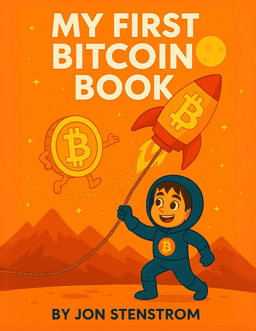
Give your kids the language behind your family treasury
My First Bitcoin Book introduces 26 Bitcoin concepts with fun illustrations, designed for ages 3-8.
Get the Book