How to Explain Bitcoin to a 10-Year-Old
I've tried explaining Bitcoin to my kids probably a dozen times. The first few attempts were terrible. Too much jargon. Too abstract. Eyes glazed over by sentence three. What finally worked was starting with something they already understood: money is broken, and someone tried to fix it.
To explain Bitcoin to a 10-year-old, start with the problem (money loses value because governments keep printing more), then introduce the fix (digital money with a hard cap of 21 million that no one controls). Skip mining, hashing, and nodes. A 10-year-old who grasps those two ideas understands Bitcoin better than most adults.
Why should you start with the problem, not the solution?
Don't lead with “Bitcoin is a decentralized peer-to-peer electronic cash system.” Lead with this: “You know how a candy bar used to cost a quarter when Grandma was a kid? Why does the same candy bar cost $2 now?”
Let them think about it. Most 10-year-olds will guess “because everything gets more expensive.” That's your opening: “Kind of. The candy didn't change. The money got weaker. Because the government keeps making more of it.”1 (Our guide on inflation for kids has the full version of this conversation.)
How do you introduce Bitcoin as the fix?
“What if someone made a kind of money where nobody could make more? Where there would only ever be 21 million of them? And instead of a bank keeping track of who has what, thousands of computers all over the world keep track together?”
That's Bitcoin. Digital money with a cap. No bank in the middle. No one in charge.
Saylor describes it as owning property in a “cyber Manhattan” built from 21 million city blocks, where eventually everyone on earth will want a piece.6 That image works well for kids who understand real estate (or Minecraft land, honestly).
What are the 3 things a 10-year-old needs to know about Bitcoin?
- Bitcoin is digital money. It lives on the internet. You can't hold it, but you can own it and send it to anyone in the world in minutes.2
- There's a fixed supply. Only 21 million bitcoin will ever exist.2 Nobody, not a president, not a CEO, not a hacker, can make more.
- Nobody controls it. No company. No government. Thousands of computers around the world all agree on who owns what, every 10 minutes.
That's it. If your kid gets those three points, they understand Bitcoin better than most adults.
What Bitcoin topics should you skip with a 10-year-old?
Don't get into mining, hashing, nodes, or the mempool. Not yet. You'll lose them. Let the basics marinate. If they ask questions (and they will), follow their curiosity. But resist the urge to brain-dump everything you know.
Kid questions about Bitcoin
- “Why can't I just use regular money?” You can. Most people do. Bitcoin is another option. Some people think it's a better way to save because the supply is fixed and can't be inflated away.3
- “Is Bitcoin money or an investment?” Both, depending on who you ask. Some people spend it. Some people save it for the long term. It's like gold in that way. The IRS actually classifies it as property.4
- “Will my school accept Bitcoin?” Probably not yet. But 10 years ago most stores didn't accept Apple Pay, and now it's everywhere. Things change.
- “How much is one bitcoin?” Pull up the price together. Then explain that you don't need a whole one. You can own a tiny fraction, called a satoshi. There are 100 million satoshis in a single bitcoin.2
Try this at home
The dinner table pitch (10 minutes, ages 10+). After explaining Bitcoin to your kid, challenge them to explain it back to another family member at dinner. Give them 60 seconds. If the other person “gets it,” the kid earns a small reward. Teaching is the best test of understanding, and 10-year-olds love proving they know something adults don't.
If you're looking for a more structured lesson, our elementary Bitcoin lesson plan turns this into a full classroom activity.
Materials: None. Time: 10 minutes.
Sources
- U.S. Bureau of Labor Statistics, CPI Inflation Calculator
- Nakamoto, Satoshi. Bitcoin: A Peer-to-Peer Electronic Cash System (2008)
- Federal Reserve, “Why does the Federal Reserve aim for inflation of 2 percent?”
- IRS, Virtual Currency Transactions FAQ
- Bitcoin.org, How Bitcoin Works
- Saylor, Michael. Interview with Anthony Pompliano, discussing Bitcoin as “Cyber Manhattan”
This site is created by a Bitcoin advocate and parent. It presents one perspective on money and financial education. Nothing here is financial advice. Bitcoin is volatile and you can lose money. Consult a licensed financial advisor before making investment decisions for your family.
Keep reading
What Is Bitcoin? Explained for Kids
A plain-English explanation of Bitcoin that you can read to your kids or use as a conversation starter at dinner.
How to Talk to Your Teenager About Bitcoin
Teenagers are allergic to lectures. Here's how to have a Bitcoin conversation with your teen that doesn't end in eye rolls. Includes a $20 experiment.
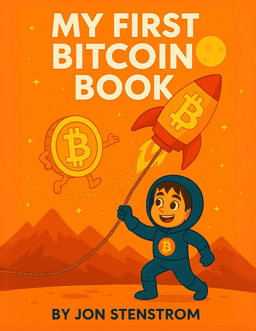
Give your kids the language behind your family treasury
My First Bitcoin Book introduces 26 Bitcoin concepts with fun illustrations, designed for ages 3-8.
Get the Book