How to Talk to Your Teenager About Bitcoin
Teenagers are allergic to lectures. If you sit your 15-year-old down and say “let me tell you about Bitcoin,” you've already lost them. The approach that works is completely different: start with what they care about, and let them arrive at Bitcoin on their own.
The best way to talk to your teenager about Bitcoin is to skip the pitch and start with a question about their money. Use an inflation calculator to show them how much their birth-year dollar has shrunk, acknowledge their objections honestly, and give them $20 in bitcoin so they learn through ownership instead of lectures.
How to start a Bitcoin conversation with your teenager
Your teen probably already knows Bitcoin exists. They might think it's a scam, a get-rich-quick thing, or just something old people talk about. All of those impressions come from somewhere (TikTok, mostly). You're not starting from zero. You're starting from a pile of impressions you need to gently sort through with them.
Try this opener: “How much do you think a dollar from 2004 is worth today?” Pull up an inflation calculator and show them. Their birth-year dollar is worth about 60 cents now.1 That gets their attention, because it's about them.
Some people call this the “melting ice cube” problem. Michael Saylor described the moment he realized his company was “sitting on a 500 million dollar ice cube and it was melting at least 10% a year.”7 Your teen's savings are doing the same thing, just slower and quieter. Once they see it in their own lifetime, they can't unsee it.
Why you should frame Bitcoin as a money conversation
The word “crypto” carries baggage: FTX collapsed in November 2022, taking $8 billion in customer funds with it.2 Meme coins, influencer scams, rug pulls. Fair enough. Separate Bitcoin from the noise. Bitcoin was the first, has no company issuing it, and the base network has been remarkably resilient over 17+ years of operation.3
Frame it as a money conversation. That changes the whole dynamic. Ask them: “If you saved $1,000 in a bank account right now, how much buying power would it have when you're 30?” At the Federal Reserve's 2% inflation target,4 the answer is about $730. At the actual average of 3%+ over the last few years, it's closer to $640. That's just the math.
How to handle your teen's Bitcoin objections
Teenagers need to disagree with you. It's biological. So don't fight it. When they say “Bitcoin is too volatile,” say “you're right, it is. It dropped 76% from $69,000 to under $16,000 in 2022.”5 When they say “it's bad for the environment,” say “it does use energy. About half of Bitcoin mining now uses renewable sources, according to the Cambridge Centre for Alternative Finance.”6
Agreeing with their objections before adding context lands far better than dismissing them. They're testing whether you've actually thought this through or are just repeating something you heard. If you want the full picture on whether Bitcoin is safe for kids, we cover the risks honestly in a separate guide.
The $20 Bitcoin experiment for teenagers
Nothing teaches faster than ownership. Buy them $20 worth of bitcoin. Put it in a wallet they control. Now they have a reason to check the price, learn how wallets work, and understand volatility firsthand.
Think of it as digital property rather than digital currency. You're not buying something to spend. You're owning a piece of something scarce. There will only ever be 21 million bitcoin.8 Your teen now owns some of that. That's a different conversation than “I bought you a gift card.”
$20 is cheap tuition for a financial education most adults don't have. If it goes to $40, they'll feel smart. If it drops to $10, they'll learn about risk. Both lessons are worth it. (If you're not sure where to start, here's our plain-English explainer on what Bitcoin actually is.)
Bitcoin topics that interest teenagers
- The “who controls money” conversation. Teens care about fairness and power. Who decides how much money to print? (The Federal Reserve.) Who benefits? Who gets hurt? Bitcoin removes the decision-maker. That resonates with a generation that questions institutions by default.
- The global perspective. In Argentina, inflation hit 211% in 2023.9 In Turkey, the lira lost 80% of its value in 4 years. In Nigeria, people use Bitcoin to send remittances home because the banking system can't keep up.10 For a teen who thinks Bitcoin is a rich-people toy, this reframes it.
- The tech angle. If your teen is into coding, gaming, or tech, the engineering behind Bitcoin is genuinely interesting. Proof of work, cryptographic hashes, distributed consensus. It's computer science. The Bitcoin whitepaper is only 9 pages.8
Mistakes to avoid when talking to teens about Bitcoin
Don't promise them Bitcoin will make them rich. Don't show them price charts going “up and to the right.” Don't tell them it's guaranteed. That sounds like every crypto influencer they've already learned to distrust. Be honest about the risks. That honesty is what builds credibility.
Common questions teens ask about Bitcoin
- “Why can't I just use Venmo?” Venmo moves dollars. When you send someone $20 on Venmo, a bank is in the middle, and those dollars lose purchasing power every year. Bitcoin moves value without a middleman, and its current rules cap the supply.
- “Why don't I just invest in stocks?” You can do both. Stocks give you ownership in companies. Bitcoin gives you ownership of a scarce digital asset that no government or company controls. Different bets for different reasons. Check out our Bitcoin vs. 529 comparison for the full breakdown.
- “My friend made a ton on [random meme coin].” Ask them if that friend kept the gains or reinvested in the next one. Speculating on random tokens is gambling. Bitcoin has been running for 17 years with no CEO, no company, and no downtime. Meme coins have a median lifespan measured in weeks.
- “What can I actually buy with it?” Right now, Bitcoin is better as a savings tool than a spending tool. Some companies accept it directly, but most people hold it because they think it'll be worth more in 10 years than it is today. Think of it like digital gold your generation gets to grow up with.
Try this at home
The $20 experiment (5 minutes to set up, ongoing). Buy $20 of bitcoin on your exchange, then send it to a wallet your teen controls (here's how to set one up). Set a calendar reminder for 6 months. Don't check the price together until that date. When you do, talk about what happened and why. The conversation that comes out of real ownership is worth more than any lecture.
Materials: A phone, $20, a Bitcoin wallet app (Muun or Blue Wallet work well). Time: 5 minutes to set up, 6 months to marinate.
Sources
- U.S. Bureau of Labor Statistics, CPI Inflation Calculator
- Reuters, “How FTX Collapsed” (Nov 2022)
- BitcoinUptime.org, Bitcoin Network Uptime Tracker
- Federal Reserve, “Why does the Federal Reserve aim for inflation of 2 percent?”
- Forkast, “Bitcoin Price Falls to More Than Two-Year Low Amid FTX Fallout” (Nov 2022)
- Cambridge Centre for Alternative Finance, Cambridge Bitcoin Electricity Consumption Index
- Saylor, Michael. Interview on The Breakdown, discussing MicroStrategy's cash reserves as a “melting ice cube” (2020)
- Nakamoto, Satoshi. Bitcoin: A Peer-to-Peer Electronic Cash System (2008)
- International Monetary Fund, Argentina Country Data (2023)
- Chainalysis, Sub-Saharan Africa Crypto Adoption Trends and Analysis (2023 Geography of Cryptocurrency Report)
This site is created by a Bitcoin advocate and parent. It presents one perspective on money and financial education. Nothing here is financial advice. Bitcoin is volatile and you can lose money. Consult a licensed financial advisor before making investment decisions for your family.
Keep reading
How to Explain Bitcoin to a 10-Year-Old
A tested approach to explaining Bitcoin to your 10-year-old. Start with the problem (money gets weaker), then introduce the fix (a fixed supply).
Should I Buy Bitcoin for My Child?
An honest look at buying Bitcoin for your kid. The case for it, the risks, and how to think about it as a parent.
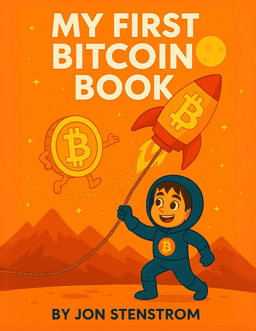
Give your kids the language behind your family treasury
My First Bitcoin Book introduces 26 Bitcoin concepts with fun illustrations, designed for ages 3-8.
Get the Book