Teaching Kids About Credit and Debt
Credit is trust turned into math. Someone believes you'll pay them back, so they hand you money now and charge a fee for the wait. That fee is called interest. The whole system runs on this one idea: I trust you enough to let you use my money today.
Most “teach kids about credit” articles stop at “debt bad, saving good.” That's half the story. The honest version is more uncomfortable: the modern financial system actually rewards smart borrowers and punishes savers who hold only cash. We need to talk about why.
What is credit?
Credit means someone lends you money and you promise to pay it back, plus a fee. If you borrow $100 at 5% interest, you owe $105. The lender is renting you their money, and the interest is the rental price.
Your credit score (a number from 300 to 850) is basically a trust rating.1 Higher score means lenders believe you'll pay them back, so they offer you lower interest rates. Lower score means higher rates, or no loan at all. Banks don't care if you're a good person. They care about the math.
Good debt vs. bad debt
A credit card charging 25% interest on a new TV? That's a trap. You'll pay for that TV twice over before you're done. The average American household carries about $10,000 in credit card debt.2 At 25% APR, the interest alone costs $2,500 per year. You're bleeding money.
Michael Saylor sorts borrowers into three buckets.3 The Gambler borrows short-term (under 5 years) or uses margin, and volatility eventually wipes them out. The Loan Shark Victim borrows at 20-30% rates (“gonna get your legs broken,” as Saylor puts it). And the Financial Genius locks in a 10-to-30-year loan below the inflation rate to buy a scarce asset.
That third category is where it gets interesting.
Why the system rewards borrowers
This is the uncomfortable part. If you save $100,000 in a savings account earning 1% interest, but inflation is running at 7%, your money lost 6% of its purchasing power in a year. (Our compound interest guide breaks down exactly how this math works against savers.) You did the “responsible” thing and got punished for it. Saylor calls this the road to serfdom: “working exponentially harder for currency growing exponentially weaker.”3
Now flip it. Say you take out a 30-year mortgage at 3% interest while inflation runs at 7%. The bank lent you dollars that are melting. Each monthly payment costs you less in real terms because the dollars you're paying back are weaker than the ones you borrowed. The bank is effectively paying you to borrow.
This is why wealthy families (like Robert Kraft) borrow against trophy assets instead of selling them.4 They keep the asset, take a low-interest loan, and let inflation eat the debt. Saylor explicitly says: never pay off a cheap 30-year mortgage early. Time and inflation are doing the work for you. (Whether that's the right call for any given family depends on the rate, the borrower, and how much risk they can stomach.)
How banks actually create money
This story starts with goldsmiths in 17th-century London. People deposited gold for safekeeping and got paper receipts. The goldsmiths noticed that everyone never came for their gold at the same time, so they started issuing 2-3x more receipts than gold they actually held. It worked great, until it didn't.5 When too many people showed up to redeem at once, the goldsmith went bankrupt.
Modern banks do a polished version of the same trick. With a 5% reserve ratio, a bank takes $1 million in deposits and creates roughly $20 million in loans. Saylor calls banks “fiat miners” because they're conjuring new currency that dilutes everyone else's savings.3 Every new dollar they lend into existence makes your existing dollars worth a little less.
Real stories: debt that destroyed and debt that built
Terra Luna (2022): Do Kwon built a $60 billion ecosystem by promising depositors 20% interest through his Anchor protocol.6 Where was the 20% coming from? Nowhere real. When confidence cracked, the entire system collapsed in 72 hours. $60 billion, gone.
FTX (2022): Sam Bankman-Fried ran a modern goldsmith fraud. Customers deposited billions thinking their money was safe. He lent it out to his own hedge fund without telling anyone.7 Same pattern as those 17th-century goldsmiths: issuing obligations without the assets to back them. He's now serving 25 years in prison.
Silicon Valley Bank (2023): SVB followed the “safe” playbook. They bought U.S. Treasury bonds with their deposits. Then the Federal Reserve raised interest rates, the value of those bonds dropped, and depositors withdrew $42 billion in a single day.8 Playing by the rules didn't save them. (And this is before tax policy enters the picture, which can shift the math overnight.)
Saylor's Argentina story: He had $1 million in Bank of America in Buenos Aires. The Argentine government forced conversion to pesos, then devalued the currency 90% overnight.3 His million became worth $100,000 in purchasing power. The lesson: money in a bank is only as safe as the government standing behind it.
What does this have to do with Bitcoin?
Self-custodied Bitcoin removes a specific kind of counterparty risk: nobody can lend out your Bitcoin without your permission if you hold the keys. No bank can use your deposit to make risky bets. Under Bitcoin's current consensus rules, only 21 million will ever exist, so the supply cannot be expanded the way a fiat currency can.9
If you hold your own keys, you don't need to trust a bank, a government, or an exchange. You skip the entire chain of promises that breaks every few years. The catch: lose the keys, and nobody can reset the password for you. That tradeoff is what makes Bitcoin a genuinely different kind of money.
How to talk to your kids about credit (parent talking points)
Fair warning: this is a weird one to teach. You're basically saying “the rules aren't what you think they are.” That's honest, though, and kids can handle honest.
- “Is borrowing money bad?” Borrowing at high interest rates for stuff that loses value (credit cards for toys, clothes, gadgets) is genuinely bad. Borrowing at low interest rates to buy something that holds value or grows? That's a different equation. The interest rate and what you buy with it are everything.
- “Why do rich people have so much debt?” Because they borrow cheap money to buy things that go up in value. They keep the asset and let inflation shrink the loan. It sounds backward, but it's how the system actually works.
- “Should I save or borrow?” Save first. Always. Understand money before you start playing with borrowed money. But as they get older, teach them that saving only in dollars means losing purchasing power every year. The goal is to understand which debt builds wealth and which debt destroys it. Avoiding debt forever isn't the answer; understanding it is.
Try this at home
The lending game (20 minutes, ages 8+). Give your kid 20 tokens (coins, buttons, whatever). They're the bank. A sibling or parent comes to borrow 10 tokens and promises to pay back 12 in five rounds. Meanwhile, announce that every round, all tokens lose 10% of their value (remove 1 token from everyone's stash each round to simulate inflation).
After five rounds, ask: who came out ahead, the saver or the borrower? The saver lost tokens to inflation every round. The borrower got to use 10 tokens immediately and paid back with tokens that were worth less. Then talk about what the borrower bought with those tokens. Something useful? Something that held its value? Or junk? That's the whole lesson in 20 minutes.
Materials: 30+ tokens, a notepad to track loans and inflation. Time: 20 minutes.
Sources
- Consumer Financial Protection Bureau, What is a Credit Score?
- Federal Reserve Bank of New York, Household Debt and Credit Report (Q4 2024)
- Saylor, Michael. Various interviews and podcasts on debt, inflation, and Bitcoin strategy (2021-2024); see Saylor on intelligent leverage
- Bloomberg, “How Billionaires Borrow Against Assets to Minimize Taxes” (buy-borrow-die strategy)
- Quinn, Stephen. “Goldsmith-Banking: Mutual Acceptance and Interbanker Clearing in Restoration London,” Explorations in Economic History, Vol. 34, 1997
- Federal Reserve Board, “Interconnected DeFi: Ripple Effects from the Terra Collapse” (FEDS Working Paper, 2023)
- U.S. Department of Justice, Samuel Bankman-Fried Sentenced to 25 Years in Prison (March 2024)
- FDIC, Silicon Valley Bank Failure (March 2023)
- Nakamoto, Satoshi. Bitcoin: A Peer-to-Peer Electronic Cash System (2008), Section 4: fixed supply of 21 million coins
This site is created by a Bitcoin advocate and parent. It presents one perspective on money and financial education. Nothing here is financial advice. Bitcoin is volatile and you can lose money. Consult a licensed financial advisor before making investment decisions for your family.
Keep reading
How Do Banks Work? Explained for Kids
Your kid thinks the bank is a vault full of cash. It's not. Banks lend out most of your money and keep a fraction on hand. Here's how to explain it without putting them to sleep.
What Is Inflation? Explained for Kids
Why does the same candy bar cost more than it used to? Here's how to explain inflation to your kids without putting them to sleep.
Why Does Money Lose Value? Explained for Kids
A candy bar used to cost a dime. Now it costs $2. Here's how to explain to your kids why money loses value over time, with real examples they'll actually remember.
Give your kids the language behind your family treasury
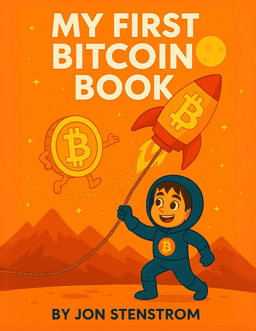
My First Bitcoin Book introduces 26 Bitcoin concepts with fun illustrations, designed for ages 3-8.
Get the Book