How to Explain Taxes to Kids
Your kid earns $10 mowing a lawn. The government takes $2 before they even see it. Then inflation quietly eats another chunk of what's left. Taxes are real, necessary, and way more complicated than “paying for roads and schools.”
Most explanations stop at “taxes help everyone.” That's partly true. But the full story includes governments changing tax rules overnight, taxing people out of their own homes, and entire economies collapsing because capital simply left. Your kids deserve the full picture.
What are taxes?
Taxes are the share of your money the government takes to pay for things everyone uses: roads, schools, fire departments, the military. Every country does this. The U.S. federal government collected about $4.4 trillion in taxes in 2023.1 That's roughly $13,000 per person, including kids.
There are different flavors. Income tax takes a percentage of what you earn. Sales tax gets added when you buy something. Property tax is charged every year on your home. Capital gains tax hits you when you sell something for more than you paid. Each one grabs a piece at a different moment.
Where does your tax money go?
About 22% goes to Social Security (payments to retired people). Another 14% goes to Medicare and Medicaid (health care). About 13% goes to defense and military spending. Interest on the national debt eats up roughly 11%, and that share keeps growing.2 Roads, schools, and science research split the rest.
These are real services that matter. Firefighters show up because taxes fund them. Public schools exist because of property taxes. The harder question is whether the rules stay fair over time. (History says: not always.)
The part most people skip: taxes + inflation
Here's where it gets uncomfortable. Taxes take from your income. Inflation takes from your savings. Both hit you at the same time. You earn $100, the government takes $25 in taxes, and inflation silently shaves another 3-7% off whatever you keep. It's a double drain.
Michael Saylor calls this the core trap of holding cash: you're taxed on the way in and debased on the way out.3 Your grandparents didn't just lose purchasing power to the Fed printing money. They lost it to taxes compounding on top of that erosion, year after year. (Our compound interest guide breaks down how this compounding works in both directions.)
How governments have changed the rules throughout history
The 2% tea tax that started a revolution. The American colonists revolted over a 1.5-2% tax on tea. They dumped 342 chests into Boston Harbor in 1773 over what amounted to pennies per pound.4 Today Americans accept 30-50% combined tax rates on income, property, purchases, and capital gains without blinking. The principle held. The tolerance moved.
The colonial tobacco police state. Britain tried to “just tax tobacco” in the colonies. It spiraled. Only British ships could carry it. Production quotas followed. The Royal Navy deployed to sink Dutch trading ships. The government recruited informants. Farmers burned their neighbors' crops to avoid penalties.5 A simple commodity tax became a full surveillance system within a generation.
The Sardinian yacht tax. A port town in Sardinia passed a luxury tax based on the assessed value of every yacht docked there. The morning the tax took effect, every yacht was gone. The marina emptied. Local restaurants, fuel stations, and shops lost their customer base overnight.6 Capital is mobile. Push too hard and it leaves.
Argentina's overnight confiscation. In 2002, the Argentine government faxed instructions to banks: convert all dollar deposits to pesos. Then they devalued the peso by roughly 70%. People who had $10,000 in savings woke up with the equivalent of $3,000.7 No vote, no warning, no due process.
Property taxes: do you really own your house?
Saylor walks through a brutal math problem. Buy a $1 million home in Florida. Property tax: 2% per year. That's $20,000 annually. The government periodically reassesses your home upward, so your tax bill grows even if you never renovate. Over 25-30 years, you've paid the entire original purchase price again, just in taxes.8
This is how families lose the farm (literally). Grandpa buys 200 acres of farmland in 1960 for $50,000. The land gets reassessed at $2 million. The family now owes $40,000+ per year in property taxes on land that produces the same number of bushels it always did. They can't afford the tax bill, so they sell. As Saylor puts it: “You never truly own physical land. You rent it from the government.”8
What this means for families thinking about Bitcoin
Saylor frames tax risk as one of his 24 risks to storing wealth.3 Governments can “put a windfall profits tax on you or a withholding tax or a value-and-use tax and just tax you out of existence.” Physical assets (homes, land, yachts) are sitting targets because they can't move.
Bitcoin doesn't have a property tax. Nobody reassesses your bitcoin upward and sends you a bill. You only trigger a tax event when you sell, exchange, or otherwise dispose of it under IRS rules. That's why wealthy families have always followed the same playbook: never sell appreciating assets, borrow against them instead.9 Selling means 20-50% goes to taxes, plus you lose all the future compounded growth on the amount you gave up. (Borrowing has its own risks. Our credit and debt guide walks through both sides.)
Bitcoin isn't tax-free. You still owe capital gains on the way out. But it can't be property-taxed, it can't be reassessed, and it can't be trapped in a port waiting for a government to change the rules.
How to explain taxes to kids (parent talking points)
- “Why does the government take our money?” To pay for things everyone shares: roads, schools, firefighters, the military. It's like chipping in for a group pizza, except you don't get to pick the toppings.
- “Is it fair?” Some taxes fund things we all need. The tricky part is that governments can change the rules anytime. History is full of examples where taxes started small and grew until people couldn't afford to keep what they owned.
- “Do you pay taxes on Bitcoin?” Yes, when you sell it for more than you paid. But nobody sends you a yearly bill just for holding it, the way they do with a house. That's one reason some people prefer to save in Bitcoin instead of physical property.
Try this at home
The tax bite simulation (15 minutes, ages 8+). Give your kid 10 quarters ($2.50) for a pretend job. Take 3 quarters away: that's income tax. Then take 1 more: that's sales tax when they buy something. Now tell them that by next year, everything costs 5% more (inflation), so their remaining 6 quarters buy even less. Ask: “How does it feel to earn 10 and keep 6, then watch prices go up anyway?”
Materials: 10 quarters. Time: 15 minutes.
Sources
- U.S. Treasury Department, Federal Revenue by Source, Fiscal Year 2023
- Congressional Budget Office, The Federal Budget in Fiscal Year 2023: An Infographic
- Saylor, Michael. Saylor Series Episode 1: Bitcoin as Digital Property, discussing tax risk, inflation drain, and the 24 risks to storing wealth
- Boston Tea Party Historical Society, The Tea Act of 1773
- Breen, T.H. Tobacco Culture: The Mentality of the Great Tidewater Planters on the Eve of Revolution (Princeton University Press, 1985)
- Saylor, Michael. Saylor Series, discussing capital mobility and the Sardinian yacht tax example
- Blustein, Paul. And the Money Kept Rolling In (and Out) (PublicAffairs, 2005), documenting Argentina's 2001-2002 financial crisis and forced peso conversion
- Saylor, Michael. Saylor Series, discussing property tax as perpetual rent and the Florida 2% trap
- BlackRock, Tax Center: Build Tax-Efficient Portfolios, on after-tax return management and tax-loss harvesting
This site is created by a Bitcoin advocate and parent. It presents one perspective on money and financial education. Nothing here is financial advice. Bitcoin is volatile and you can lose money. Consult a licensed financial advisor before making investment decisions for your family.
Keep reading
What Is Inflation? Explained for Kids
Why does the same candy bar cost more than it used to? Here's how to explain inflation to your kids without putting them to sleep.
What Is the Federal Reserve? Explained for Kids
The Federal Reserve influences money and credit in America. Your kid has probably never heard of it, but it affects prices, borrowing, and saving.
Why Does Money Lose Value? Explained for Kids
A candy bar used to cost a dime. Now it costs $2. Here's how to explain to your kids why money loses value over time, with real examples they'll actually remember.
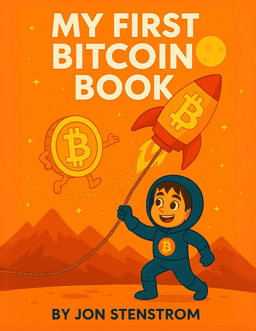
Give your kids the language behind your family treasury
My First Bitcoin Book introduces 26 Bitcoin concepts with fun illustrations, designed for ages 3-8.
Get the Book