The Bitcoin Parent Treasury: A System for Long-Term Family Wealth
We're parents sharing what we've learned, not financial advisors. Some links may pay a referral. Full disclosure.
Most parents save in dollars for a world that won't exist. The school says to. The 401(k) form auto-fills it. The financial advisor reinforces it. And every year, the dollar buys less, and the kids inherit the consequences.
A Bitcoin Parent Treasury is a system for thinking about your family the way a corporate CFO thinks about the balance sheet. Long-term. Sovereign. Generational. The unit isn't this month's budget. It's the next 30, 50, 100 years. This is the playbook I'm building for our family. Take what fits, ignore what doesn't.
The default starter stack
If you want the practical version, don't overcomplicate it. For most parents, the starter stack is three pieces:
- Recurring Bitcoin buys: River for weekly or monthly buys, especially if you want a Bitcoin-only platform with 0% fee recurring orders and auto-withdrawal to your own wallet.6
- Kid money practice: Cash App Managed Accounts for ages 6-12, then Sponsored Accounts when they're old enough to start learning the on-ramp.
- Custody: a hardware wallet once balances are meaningful, with the seed phrase backed up in two places and documented for your spouse or heirs.
That is enough to start. The point is not to buy every product. The point is to turn the family treasury from an idea into a repeatable system. I keep the current recommended services, custody tools, and books on the Resources page so this article can stay focused on the system.
What is a family treasury?
A treasury is the part of your balance sheet you don't spend. Companies hold cash, bonds, and (increasingly) Bitcoin in their treasury. Strategy (formerly MicroStrategy) holds over 818,000 bitcoin on their corporate balance sheet as of May 2026.1 They aren't trying to spend it. They're preserving and growing long-term value.
Most families don't have a treasury. They have a checking account, maybe an emergency fund, maybe a 529, maybe a 401(k). What they don't have is a coordinated, long-term, scarce-asset reserve with a written policy for when and how it grows, where it lives, and who inherits it.
A family treasury is exactly that. A separate pool. A long time horizon. A custody plan. A handoff plan. A teaching plan. The point isn't this year's tax return. The point is whether your great-granddaughter inherits something that still exists.
Why long-term store of wealth matters more for parents
The window is the kid. A 5-year-old has 80 years ahead of them. A 12-year-old has 70. The compounding window for a child is ridiculous compared to your own. A bitcoin you set aside today and don't touch could be the difference between your great-grandkid renting and owning.
Saylor put it directly at the Bitcoin 2025 conference: “Your children have time and potential. The secret is transferring capital into their hands. Families that move in unity are unstoppable.”2 That's not just inspirational copy. It's the strategy. Capital from older generations, mediated by parents, deployed for the youngest. Time is the resource that compounds.
The other word for this is low time preference. High time preference says “spend the candy bar today.” Low time preference says “I'll wait two days, get two candy bars.” Money systems shape time preference. Fiat currency, which loses value, pushes everyone toward high time preference. Why save what's melting? Bitcoin, with a supply cap of 21 million under its current consensus rules, points the other direction. You can save in it without watching it melt.
Lower your family's time preference and you change everything they think about. School subjects matter more. Skills compound longer. Decisions look further out. That's the cultural shift a treasury creates inside a household. (Want to teach this to your kid? Start with our delayed gratification guide.)
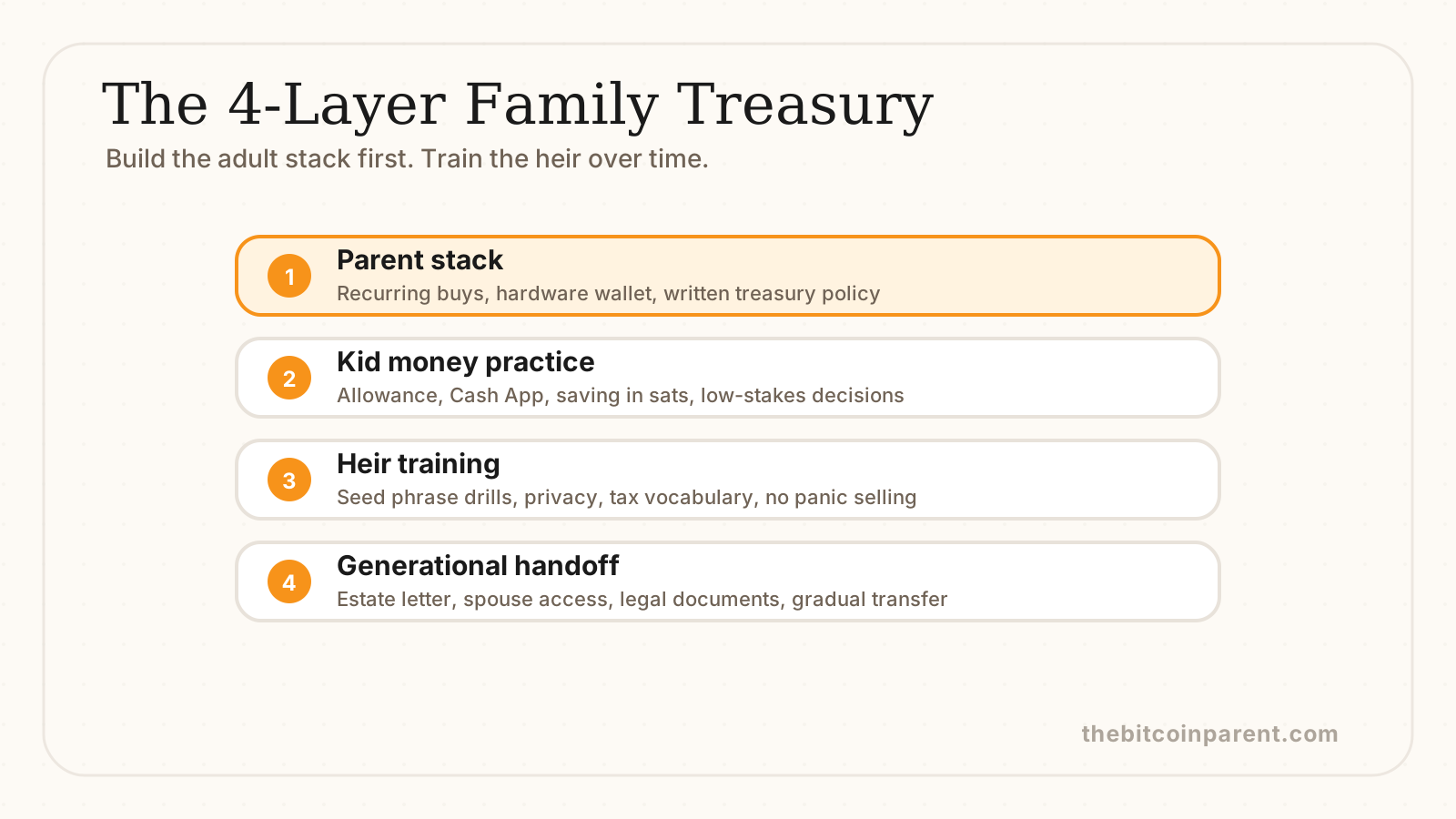
The four layers of the system
A Bitcoin Parent Treasury has four layers. Most families I see start with one and never build the others. The system gets stronger when all four are running.
Layer 1: The adult treasury (your stack)
Your own Bitcoin position with proper custody. Self-custody on a hardware wallet (Trezor is the default), or multisig through a service like Unchained. Recurring DCA from an exchange like River. Seed phrase backed up on paper or metal, in a fireproof location. A second copy in your estate documents.
This is the foundation. If you don't have it, the other layers don't matter. A parent who hasn't figured out their own custody can't responsibly hand keys to a kid. Start with the family custody starter kit, then use the full wallet setup guide when you are ready to move sats.
Layer 2: The kid layer (accounts that grow with the child)
Most parents miss this layer entirely. The path I'd run, by age:
- Ages 6-12: Cash App Managed Accounts (launched April 2026). Kids learn the mechanics, saving, spending, a debit card with limits, without touching crypto yet. Parents stay in full control.3 If you're new to Cash App, you can use my invite link.
- Age 13: Cash App graduates to a Sponsored Account. Now the teen can buy Bitcoin and stocks with parent approval. They start stacking sats.
- Age 16-18: Their own wallet. Hardware wallet. Manage their seed phrase under your supervision. The transition from “parent's stack” to “their stack” is gradual.
- At adulthood: They graduate with a balance sheet, custody habits, and a financial vocabulary most adults don't have.
Layer 3: Heir training (the teaching)
A treasury without trained heirs gets squandered. The lessons compound. By the time your kid is 18, they should know:
- Why money loses value (inflation, money supply expansion)
- Why Bitcoin is different (fixed supply, no counterparty risk if self-custodied)
- How to send and receive Bitcoin
- How to back up and protect a seed phrase
- The difference between paper assets and bearer assets
- Why time horizon is the most important variable in any investment
That's not an MBA. It's a 7th-grade-level curriculum if you start early. Our homeschool pillar walks through the lessons by age.
Layer 4: Generational handoff (the legal stack)
This is the layer almost everybody ignores. You can build a perfect Bitcoin position and still lose it through bad estate planning.
The basics:
- A will that mentions your Bitcoin specifically (not just “all assets”)
- A letter to your heirs explaining where the keys are and how to use them, kept with the will, not on a server
- A spouse who knows how the system works
- A backup heir designated, in case you and your spouse die together
- For meaningful stacks: a dynasty trust. Saylor mentions Florida (good for up to 360 years under current state law) and South Dakota (truly perpetual, since the state abolished the rule against perpetuities in 1983).25 This is sophisticated estate planning. Talk to an estate attorney licensed in your state of choice before going anywhere near it.
Without this layer, your family treasury dies with you. With it, it survives generations.
What about Bitcoin mining for tax breaks?
Mark Moss has been pitching Bitcoin mining hardware as a tax strategy: buy ASIC miners, claim 100% bonus depreciation in year one under IRS §168(k), offset taxable income, mine Bitcoin, repeat. There's a productized version called TaxShield from Arch Lending and Blockware that packages the loan, the miners, and the tax mechanics together.4
Honest take: this is built for sophisticated investors with serious taxable income (think $150K+). The upfront capital is substantial, the tax mechanics require a real CPA, and the operational complexity (hosted mining, loan servicing, depreciation schedules) takes work. If you're already running an LLC and shopping for §168(k) deductions, talk to your accountant. If you're a parent stacking $100/month in sats, ignore it for now.
Where to start: first 3 actions this week
Don't try to build the whole system at once. Three actions, in order:
- Start or clean up your recurring buy. If you don't have one, set up a small weekly buy on River or another Bitcoin-focused exchange. If you already have Bitcoin sitting on an exchange, move meaningful balances to a hardware wallet. Back up the seed phrase on paper or metal, in two places, in fireproof storage. This is Layer 1.
- Set up the kid layer at the right entry point. Under 6: nothing yet. 6-12: Cash App Managed. 13+: Cash App Sponsored plus a small Bitcoin position.
- Write the letter. One page. Where the keys are. How to access them. Who to call. Put it with your will.
Three actions. A weekend of work. The treasury isn't built yet, but the foundation is set. Everything else compounds from there.
Common parent questions
- “Why Bitcoin and not just a 529?” A 529 is a tool with a specific use (education). Bitcoin is a long-term store of value with no use restrictions. A lot of families end up using both. The 529 is the floor for college. Bitcoin is the ceiling for everything else. (Side-by-side comparison in our Bitcoin vs. 529 plan guide.)
- “What if Bitcoin goes to zero?” Possible. After 17+ years of running, the probability is low, but it's real. That's why the treasury isn't 100% Bitcoin, and why other layers (529, retirement accounts, traditional savings) coexist with it.
- “How much should the family treasury hold in Bitcoin?” Personal call based on your risk tolerance and other assets. Some families anchor at 5%. Others at 50%. The principle: it's the part you don't touch.
- “When do I tell the kids about it?” Earlier than you think. Show them the price on your phone. Explain why you save it. Walk them through a transaction. By 13 they should be active participants. (See our age-by-age guide.)
Why early and often beats once and big
Saving habits aren't built in a single sit-down lesson. They're built by repetition over years. A 5-year-old who watches you check the bitcoin price on Sunday for ten years has the long-term-savings habit wired in before they can drive. A 15-year-old who hears about money for the first time when they get a debit card is starting from zero.
The Family Treasury Policy below is a yearly anchor. The real work happens between updates: the small comments at the grocery store, the price chart on Sunday, the question “do you actually want this, or are you just bored,” the tiny sat-gift on a birthday. Those repeated moments compound the same way the sats do.
Start as early as the kid is verbal. Repeat as often as the moment fits. Hard money principles sink in the same way a language does: through exposure, not lectures.
Try this at home
The Family Treasury Policy (30 minutes, ages 12+). Sit down with your kid (if old enough) and write a one-page treasury policy. Cover: how much we save monthly, where it lives, what the goal is, what we won't sell it for. Tape it to the fridge. Update it yearly. Most families have never done this exercise. Doing it together teaches more than any lesson.
Materials: One sheet of paper. A pen. Time: 30 minutes to write. A lifetime to maintain.
Sources
- Strategy (formerly MicroStrategy), Bitcoin purchases dashboard showing 818,334 BTC held as of late April 2026; cross-referenced via BitcoinTreasuries.net
- Saylor, Michael. “21 Ways to Wealth” keynote, Bitcoin 2025 Conference (May 29, 2025), discussing family cooperation, generational capital transfer, and dynasty trusts
- Cash App (Block, Inc.), “Cash App Helps Families Build Healthy Financial Habits Together with New, Parent-Managed Accounts for Kids” (April 21, 2026)
- Arch Lending, Mark Moss, and Blockware, “TaxShield” product launch (October 21, 2025), explaining IRS §168(k) bonus depreciation strategy for Bitcoin mining hardware
- South Dakota Codified Laws § 43-5-8 (rule against perpetuities abolished, 1983) and Florida Statutes § 689.225 (360-year limit). For comparison see South Dakota vs. Florida trust law comparison.
- River Financial, What Is Dollar-Cost Averaging Bitcoin? (zero-fee recurring orders and recurring buy automation)
This site is created by a Bitcoin advocate and parent. It presents one perspective on money and financial education. Nothing here is financial advice. Bitcoin is volatile and you can lose money. Consult a licensed financial advisor before making investment decisions for your family.
Keep reading
How Much Bitcoin Do You Need to Retire as a Parent?
How much BTC to retire as a parent: use family spending, the 4% rule, an 8% Bitcoin case, child costs, volatility buffers, and realistic BTC targets.
Should I Buy Bitcoin for My Child?
An honest look at buying Bitcoin for your kid. The case for it, the risks, and how to think about it as a parent.
Bitcoin vs. 529 Plan for Your Child
A side-by-side comparison of Bitcoin savings and 529 plans for your kid. Tax benefits, flexibility, risk, and why a lot of families end up using both.

Teach the next steward of your family treasury
My First Bitcoin Book is the easiest way to make Bitcoin language normal at home. 26 concepts, fun illustrations, designed for ages 3-8.
Buy on Amazon