Bitcoin Savings Account for Your Child
We're parents sharing what we've learned, not financial advisors. Some links may pay a referral. Full disclosure.
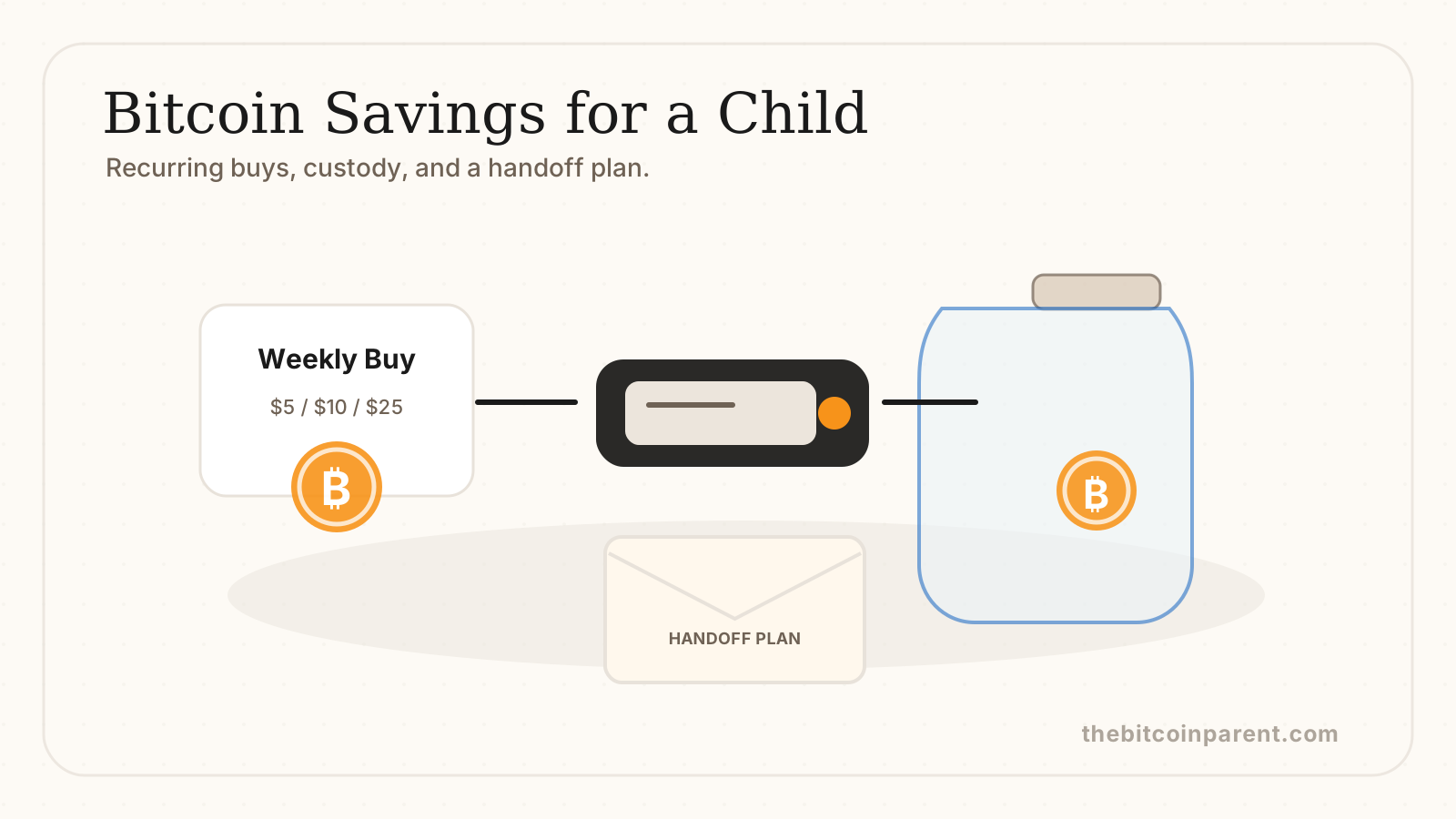
There's no “Bitcoin savings account” the way there's a bank savings account. No FDIC insurance. No guaranteed interest rate. What people actually mean when they search for this: a way to regularly buy and hold Bitcoin for their kid, ideally with some structure around it.
A Bitcoin savings plan for a child is three things bolted together: a recurring buy schedule on an exchange like River (0% fee on recurring buys1), a hardware wallet for custody, and a plan for when you'll hand the keys to your child. You can start with as little as $5/week. Think of it as the kid layer of the family Bitcoin treasury: small enough to survive mistakes, structured enough to teach long-term ownership.
Alexander Leishman, River's founder, puts the mental model bluntly:
What are you actually building?
- A recurring buy schedule (how much, how often)
- A custody solution (where the Bitcoin lives)
- A handoff plan (when and how the kid gets it)
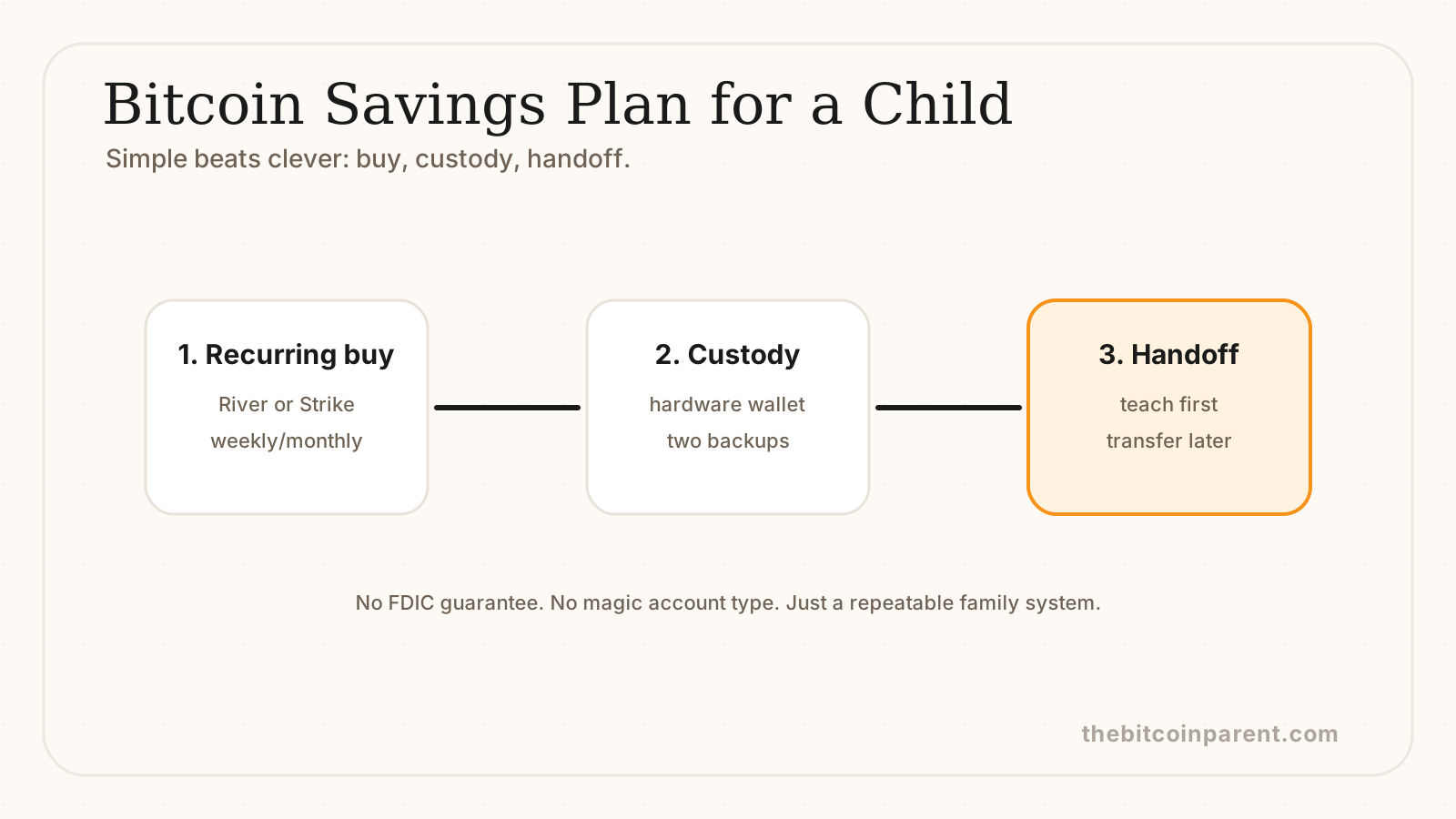
That's it. No special account type needed. No minimum balance. You can start with $5/week. Saylor framed the urgency well: he realized his company's cash was a “melting ice cube” losing “at least 10% a year, but probably 20% a year” to purchasing power erosion.10 Your kid's savings account faces the same problem on a smaller scale. A bank account earning 4% while inflation runs at 3-5% is treading water at best.2
Fit the kid account into the larger treasury
Before increasing the weekly buy, map this plan against the Bitcoin Parent Treasury system: parent cold storage first, kid learning balance second, and clear handoff instructions last. Use Resources for the current exchange, wallet, and custody-tool links.
Which platform should I use for recurring Bitcoin purchases?
You want an exchange that supports auto-recurring purchases and has low fees. The fee difference matters over 18 years of weekly buys.
- River: 0% fee on recurring buys.1 Auto-withdrawal to your own wallet. Bitcoin-only. This is what I use, and what I'd point most parents toward for a Bitcoin-only recurring plan.
- Strike: Very low fees (~0.3%).3 Simple interface. Good auto-buy feature. Also Bitcoin-focused.
- Cash App: 1.5-2.5% spread on each buy.4 Convenient but the fees eat into your stack over time. On $25/week, that's roughly $20-30/year in extra fees compared to River.
- Coinbase: Fees vary, but typically 1-2% for recurring buys. Fine but more expensive than the Bitcoin-only options.
River is also pushing toward a Bitcoin-native checking/savings workflow for parent operating cash. Their official setup is:
Here's how to set it up on River:
1. Direct deposit your paycheck
2. Auto-convert (part of) it to bitcoin, no fees
3. Earn 3.3% on any cash, paid in bitcoin
4. Use a credit card you already have
5. Auto-pay bills with BTC or cash, no fees
Leishman's credit-card version is the cleaner household cash pattern:
That can be useful for household cash, but don't blur it with your child's long-term stack. Use exchange automation for buying, then withdraw meaningful balances to your own wallet. A cash account earning Bitcoin rewards is not the same thing as lending out your kid's Bitcoin for yield.
How much should I invest and how often?
Weekly beats monthly for dollar-cost averaging (more entry points smooth out volatility), but either works. What matters is consistency.
- $10/week ($520/year): A solid starting point. Over 18 years, you'll contribute $9,360 total.
- $25/week ($1,300/year): More aggressive. $23,400 total over 18 years.
- $50/month ($600/year): The minimum I'd suggest if you're serious about this as a savings vehicle. $10,800 over 18 years.
Pick an amount you can sustain through a bear market. When Bitcoin drops 60%, your instinct will be to pause. The whole point of DCA is that you keep going. Pick a number small enough that you actually can.
How should I set up custody for my child's Bitcoin?
For the first few months, leaving the Bitcoin on the exchange is fine. Once you've accumulated $200-500+, move it to a hardware wallet. (Full walkthrough in our wallet setup guide.)
My setup:
- Buy weekly on River (auto-recurring)
- Withdraw to a Trezor hardware wallet once a quarter
- Seed phrase stored in a fireproof safe, separate from the device
- A second copy of the seed phrase stored with my estate documents
River has an auto-withdrawal feature that sends your Bitcoin to a wallet address you specify whenever your balance hits a threshold. Set it to $250 and forget about it.
Why should I track my cost basis?
This sounds boring but it'll save you (or your kid) thousands in taxes later. The IRS treats Bitcoin as property,5 so every purchase creates a tax lot. Every time you buy, record:
- Date of purchase
- Amount of Bitcoin (in sats)
- Price per Bitcoin at time of purchase
- USD amount spent
A simple spreadsheet works. River and Strike also keep transaction history you can export. When you eventually gift the Bitcoin to your kid, this cost basis transfers to them.5 If they sell without it, they could end up paying more tax than necessary. (More on the tax side in our can minors own Bitcoin guide.)
Why should I avoid “Bitcoin yield” accounts?
Some companies have offered “earn interest on your Bitcoin” accounts. Celsius offered 6-8% APY on Bitcoin deposits. Then it went bankrupt in 2022 and customers lost billions.6 BlockFi, same story.7 Voyager, same story.8
If someone is offering you yield on your Bitcoin, they're lending it out. That means counterparty risk. For a savings account meant to last 18 years, counterparty risk is the thing that can ruin the entire plan. Hold your own keys. Earn 0% yield and sleep well.
What could a Bitcoin savings plan be worth in 18 years?
Nobody can predict Bitcoin's price. But we can model scenarios to understand the range of outcomes for a $25/week plan ($23,400 total contributed):
- Flat case (0% return): Your kid has $23,400 before fees and taxes. You basically saved cash with extra steps and much more volatility.
- Moderate case (15% annual return): Roughly $150,000.
- High-return case (30% annual return): Over $1 million. Bitcoin's actual CAGR since 2013 has been higher than this,9 but expecting it to continue would be aggressive.
The asymmetry is the point. The downside is you saved $23,400 that's worth less. The upside is life-changing. Bitcoin can also underperform for long stretches, and the custody is on you. That's why you size it as money you can afford to lose, not your kid's entire savings. (Still weighing the decision? Start with should I buy Bitcoin for my child, or compare it to a 529 plan.)
How do I explain a Bitcoin savings plan to my kid?
- “Is this like my piggy bank?” Similar idea, different tool. Your piggy bank holds dollars. This is Bitcoin, which works differently. The amount of Bitcoin stays the same, but what it's worth in dollars changes every day. (Here's what Bitcoin is in kid-friendly terms.)
- “Why don't you just put it in the bank?” Banks pay almost nothing in interest right now. A savings account might earn 4% in a good year.2 I think Bitcoin has a chance of doing much better over the next 15 years. But it's riskier, so we do both.
- “What if Bitcoin goes to zero?” Then we lose this savings, and that would hurt. That's why we don't put everything into Bitcoin. This is one part of how we save, not the whole thing.
Keep the frame simple: this is not the whole family plan. It is the kid layer of a larger family treasury, sized so your child can learn from Bitcoin without putting the household balance sheet at risk.
Try this at home
The DCA simulator (15 minutes, ages 10+). Go to dcabtc.com and plug in different scenarios: $10/week starting 5 years ago, 3 years ago, 1 year ago. Show your kid how the same amount of money buys different amounts of Bitcoin depending on when you buy, and how buying consistently smooths out the highs and lows. Then set up their actual recurring buy together.
Materials: A computer or phone, dcabtc.com. Time: 15 minutes.
Sources
- River Financial, What Is Dollar-Cost Averaging Bitcoin? (zero-fee recurring orders)
- FDIC, National Rates and Rate Caps (savings account averages)
- Strike, Strike Fee Schedule
- Cash App, Cash App bitcoin fees
- IRS, Frequently Asked Questions on Virtual Currency Transactions
- Reuters, “Celsius Network files for bankruptcy” (Jul 2022)
- SEC, “BlockFi Agrees to Pay $100 Million in Penalties”
- Wikipedia, Voyager Digital (Chapter 11 bankruptcy filed July 5, 2022)
- CaseBitcoin, Bitcoin Historical Returns & CAGR Charts (data source: Messari.io)
- Saylor, Michael. Interview on The Breakdown, describing MicroStrategy's cash as a “melting ice cube” (2020)
This site is created by a Bitcoin advocate and parent. It presents one perspective on money and financial education. Nothing here is financial advice. Bitcoin is volatile and you can lose money. Consult a licensed financial advisor before making investment decisions for your family.
Keep reading
How to Buy Bitcoin for Your Child
The actual step-by-step for buying Bitcoin for your kid. Which exchange, how much, where to store it, and the tax stuff nobody warns you about.
Bitcoin vs. 529 Plan for Your Child
A side-by-side comparison of Bitcoin savings and 529 plans for your kid. Tax benefits, flexibility, risk, and why a lot of families end up using both.
How to Set Up a Bitcoin Wallet for Your Kid
Exchange wallets, mobile wallets, hardware wallets. Which one to use for your kid's Bitcoin, when to upgrade, and the seed phrase talk every parent needs to have.
Teach the next steward of your family treasury
My First Bitcoin Book is the easiest way to make Bitcoin language normal at home. 26 concepts, fun illustrations, designed for ages 3-8.
Buy on Amazon