Bitcoin vs. 529 Plan for Your Child
We're parents sharing what we've learned, not financial advisors. Some links may pay a referral. Full disclosure.
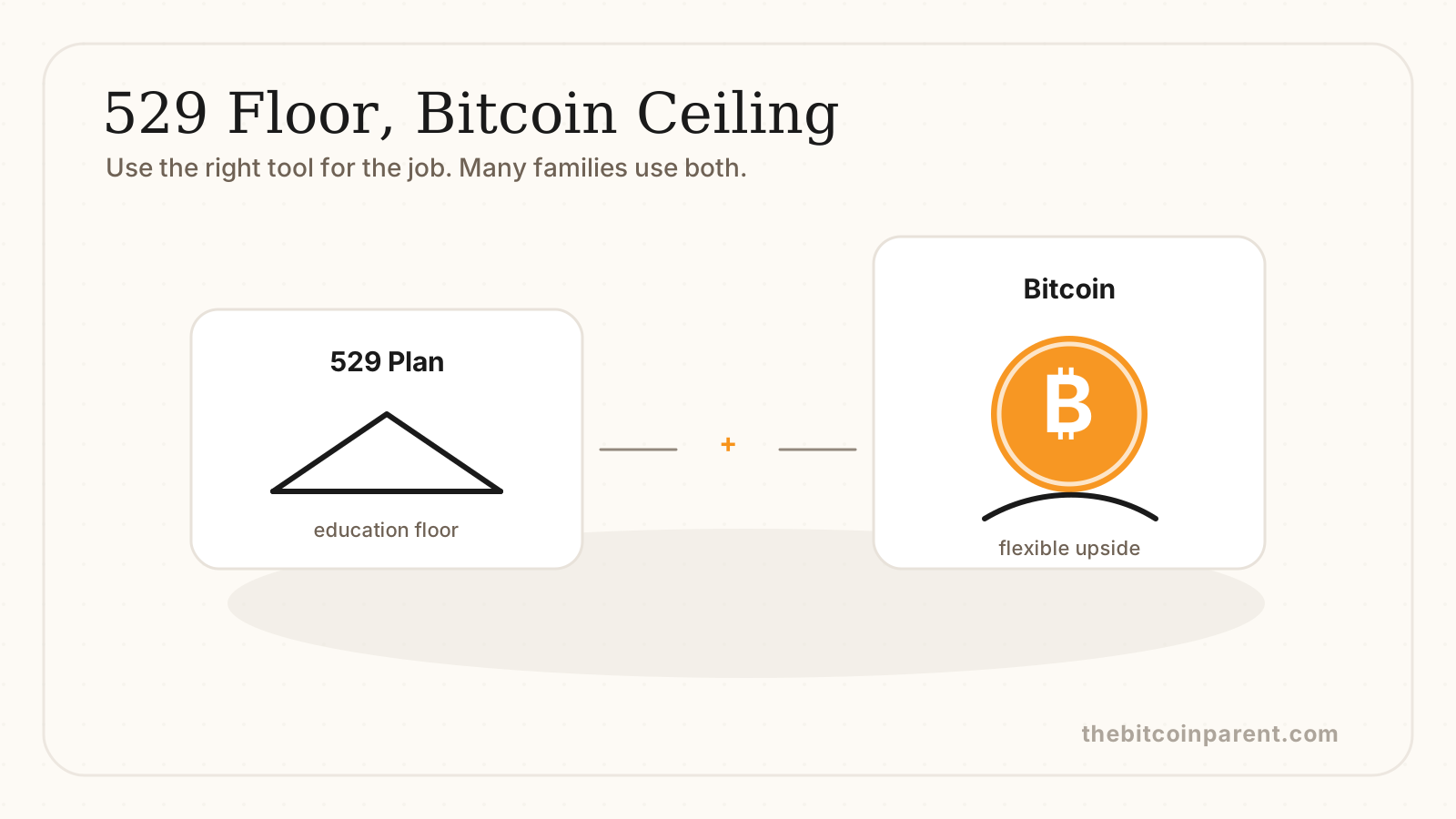
I have both. A 529 plan and a Bitcoin stack for my kids. Some people treat this as an either/or decision, but it doesn't have to be. Better question: what does each one actually do, and which mix fits your family?
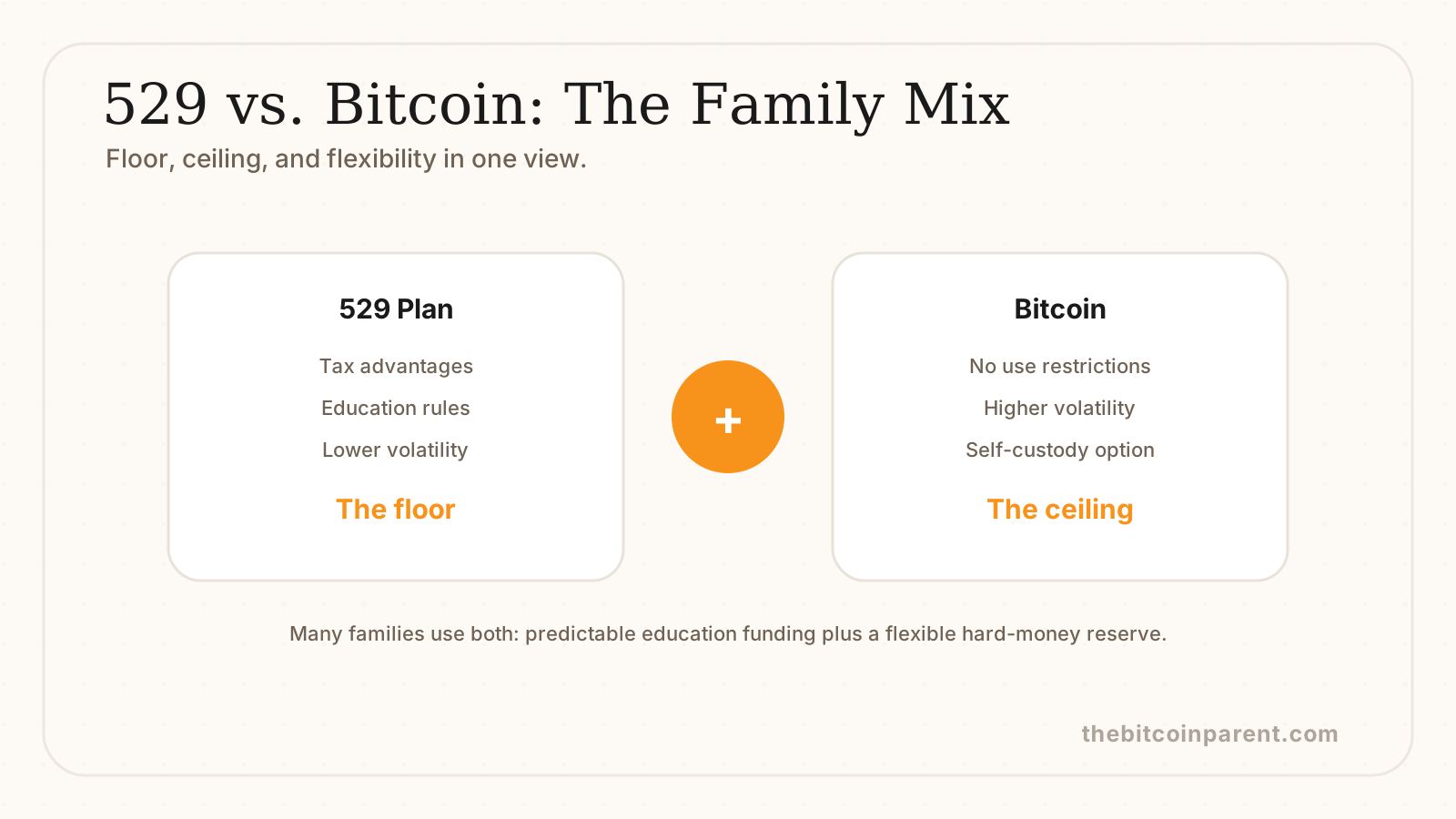
A 529 plan offers tax advantages when the money is used for qualified education expenses. Bitcoin offers total flexibility with much higher volatility and no tax-advantaged wrapper. A lot of families end up using both: a 529 as the floor (real tax benefits, low volatility) and Bitcoin as the ceiling (uncapped upside, no use restrictions).
What is a 529 plan and how does it work?
A 529 is a tax-advantaged savings account specifically for education expenses. You contribute after-tax dollars, the money grows tax-free, and withdrawals are tax-free as long as you use them for qualified education costs. Current IRS rules cover qualified higher education expenses and certain elementary, secondary, and credentialing expenses.1 State rules can differ, so check your own plan before relying on a specific expense.
The upside: tax benefits when you follow the rules. About 30 states offer a state income tax deduction for 529 contributions,2 so you get an immediate tax break on top of the tax-free growth.
The downside: the money is locked into education spending. If your kid doesn't go to college, you can roll it to another family member, roll limited long-term 529 funds to a Roth IRA, or withdraw nonqualified funds and pay tax plus the additional 10% tax on the earnings portion. The Roth path has rules: the account generally must be at least 15 years old, rollovers count against annual Roth IRA contribution limits, the beneficiary needs taxable compensation, and the lifetime cap is $35,000.3
What does a Bitcoin savings plan look like?
There's no special “Bitcoin 529.” You're just buying Bitcoin in your name (or in a UTMA custodial account) and holding it for your kid. No tax-advantaged wrapper. No restrictions on how they use it. (Full setup walkthrough in our Bitcoin savings plan guide.)
The upside: total flexibility. Your kid can use it for college, a business, a house down payment, or just keep holding it. And if Bitcoin does what it's done over the last 15 years, the returns could make the tax disadvantage irrelevant.
The downside: volatility and taxes. Bitcoin has dropped 70-80% multiple times.4 There's no tax deduction for buying it, and when you sell or gift it, capital gains tax applies.5
Saylor called his company's cash reserves a “melting ice cube” losing 10-20% of purchasing power per year.8 A 529 invested in a stock index fund melts slower (stocks generally outpace inflation), but it's still tied to the same dollar. Bitcoin is the bet that there's a harder asset to park your savings in.
How do Bitcoin and 529 plans compare side by side?
| 529 Plan | Bitcoin | |
|---|---|---|
| Tax benefits | Tax-free growth, state deductions2 | None (capital gains apply)5 |
| Use restrictions | Education only (mostly) | None |
| Volatility | Low to moderate (depends on fund) | High (70%+ drawdowns have happened)4 |
| Historical returns | 6-8% average (stock-based)6 | ~50%+ annualized (past 10 years, not guaranteed)7 |
| Liquidity | Penalty for non-education use | Sell anytime, 24/7 |
| Custody | Brokerage manages it | You manage it (or use an exchange) |
The question nobody's asking: will college even matter?
Every 529 article assumes the legacy education system will still be the destination 18 years from now. That assumption is getting weaker every year.
Alpha School in Austin runs a two-hour academic day on AI tutors. Kids master a full grade level in roughly 22 hours of focused study (about 10x faster than traditional pacing) and score in the top 1-2% nationally on MAP Growth tests.13 Geoffrey Hinton (the “Godfather of AI”) flagged it on the BBC as a credible model for the future of school. Tuition runs up to $65,000 a year at some campuses, so it isn't the answer for most families. The point is the model is real, it works, and it's scaling.
On the other end: Saylor University (formerly Saylor Academy, renamed March 2026) offers a tuition-free, ASIC-accredited MBA. Total program cost is the proctored exam fees, $75 to $225 for the whole degree.14 Same for their other graduate programs. The cost of credentialing is collapsing toward zero for self-motivated learners.
Wayne Gretzky's line: skate to where the puck is going, not where it's been. The 529 plan is built for the puck's last position: a 4-year residential degree at a traditional university, paid for in dollars. That puck is moving. Nobody knows exactly where it lands, but the direction is away from the legacy system, not toward it.
That's the case for keeping a meaningful piece of your kid's long-term savings outside the 529 wrapper. Bitcoin doesn't care what your kid spends it on. If college is still the answer in 2044, great. If college has become a niche path and your kid is running a startup or buying a house at 22, the Bitcoin works for that too.
Should I do both a 529 and Bitcoin?
You don't have to pick one. $200/month to a 529 and $50/month to Bitcoin gives your kid a solid education fund and a shot at something bigger. The 529 is the floor. Bitcoin is the ceiling. (Still deciding whether Bitcoin belongs in the mix? Start with should I buy Bitcoin for my child.)
One scenario to think about: if you put $50/month into Bitcoin for 18 years and Bitcoin averages even 20% annual returns (well below its historical average), that $10,800 in contributions becomes roughly $130,000. At the historical average, the numbers get absurd. But past performance isn't a promise. Could also be worth $3,000 in a bad scenario.
My approach: I max out enough in the 529 to cover 2-3 years of in-state tuition, then put additional savings into Bitcoin. If Bitcoin does well, the kid has options beyond college. If Bitcoin does poorly, the 529 still covers school.
How do I explain the 529 vs. Bitcoin tradeoff to my kid?
- “What's a 529?” It's a special savings account the government created for college money. You put dollars in, and they grow without being taxed, as long as you use them for school. Here's how regular savings accounts work for comparison.
- “Why not just put it all in Bitcoin?” Because Bitcoin could go down a lot right when you need it. The 529 is more predictable. We use both so we're covered either way. You can see the risks spelled out in our safety guide.
- “What if I don't want to go to college?” That's part of why we save some in Bitcoin too. It's not locked into education. You could use it for a business, a house, or just keep saving. The 529 money can also be moved to a retirement account now, so it won't go to waste.
Try this at home
The two-jar experiment (10 minutes, ages 10+). Label one jar “College Only” and one jar “Anything.” Give your kid $10 in coins. Ask them to split it however they want between the two jars. The catch: money in the College jar earns an extra quarter each week (tax benefit), but can only be used for school supplies. Money in the Anything jar doesn't earn the bonus, but can be used for whatever they want. Check in after a month and talk about the tradeoff.
Materials: Two jars, $10 in coins, quarters for weekly bonus. Time: 10 minutes setup, 2 minutes/week.
Sources
- SEC Investor.gov, An Introduction to 529 Plans (Investor Bulletin)
- Saving for College, 529 Plan State Tax Deduction Comparison
- Congress.gov, SECURE 2.0 Act of 2022 (Section 126: 529-to-Roth rollover provision)
- Forkast, “Bitcoin Price Falls to More Than Two-Year Low Amid FTX Fallout” (Nov 2022)
- IRS, Frequently Asked Questions on Virtual Currency Transactions
- Vanguard, S&P 500 Index Fund (VFIAX) Performance
- CaseBitcoin, Bitcoin Historical Returns & CAGR Charts (data source: Messari.io)
- Saylor, Michael. Interview on The Breakdown, discussing MicroStrategy's cash reserves as a “melting ice cube” (2020)
- Alpha School, “The Two-Hour School Day: How AI Tutors Are Redefining Learning Efficiency”. MAP Growth data showing top 1-2% national performance and 2.3x annual growth rate vs U.S. norms.
- Saylor Academy, Saylor Academy degree programs, ASIC International Accreditation; total program cost is $75-225 in proctored exam fees.
This site is created by a Bitcoin advocate and parent. It presents one perspective on money and financial education. Nothing here is financial advice. Bitcoin is volatile and you can lose money. Consult a licensed financial advisor before making investment decisions for your family.
Keep reading
Should I Buy Bitcoin for My Child?
An honest look at buying Bitcoin for your kid. The case for it, the risks, and how to think about it as a parent.
Bitcoin Savings Account for Your Child
There's no 'Bitcoin savings account' at a bank. Here's what a Bitcoin savings plan for your kid actually looks like: recurring buys, hardware wallet custody, and cost basis tracking.
How to Buy Bitcoin for Your Child
The actual step-by-step for buying Bitcoin for your kid. Which exchange, how much, where to store it, and the tax stuff nobody warns you about.
Build the worldview your treasury needs
My First Bitcoin Book helps kids learn the words behind saving, scarcity, self-custody, and sats.