Is Bitcoin Safe for Kids?
We're parents sharing what we've learned, not financial advisors. Some links may pay a referral. Full disclosure.
Depends on what you mean by “safe.” Is the Bitcoin network secure? Yes, it hasn't been hacked in 17 years.1 Will the price stay stable? Absolutely not. Could your kid lose their Bitcoin through carelessness or scams? Yes.
Bitcoin is safe enough for kids if parents handle custody properly and size the position appropriately. The base network has run nonstop for 17+ years without a successful attack,1 but the price has dropped 70-80% multiple times.2 The real risks are sloppy custody (exchange collapses, lost keys) and scams targeting kids on social media. Use a hardware wallet, dollar-cost average, and teach your child to spot scams.
Is the Bitcoin network secure?
Bitcoin has been running since January 3, 2009.1 In that time, the base network has never been compromised. Not once. It's secured by thousands of computers worldwide, running 24/7, and the cost to attack it is measured in billions of dollars.3 As a technology, it's one of the most battle-tested systems in computing history.
When you hear about “Bitcoin hacks,” that's almost always an exchange or a wallet app that got hacked, not Bitcoin itself. The difference matters. If someone breaks into a bank vault, you don't say the dollar got hacked.
How volatile is Bitcoin's price?
Bitcoin's price history is wild. Some numbers to understand what you're signing up for:
- 2017: rose from $1,000 to $19,000, then fell to $3,200 (83% drop)2
- 2021: rose from $29,000 to $69,000, then fell to $16,000 (77% drop)4
- Through 2025, every 4-year holding period in Bitcoin's history has ended higher.5 Past performance, not a promise.
If you're holding Bitcoin for a child with a 15-18 year time horizon, the historical data is encouraging. If you need the money in 2-3 years, you could be selling at the bottom of a cycle. Time horizon is everything. (Our guide to buying Bitcoin for kids goes deeper on sizing the investment.)
What are the biggest custody risks for families?
For most families, the danger comes from one of these:
- Exchange collapse. FTX, Celsius, BlockFi, and Voyager all went bankrupt. FTX alone lost $8 billion in customer funds.6 If your Bitcoin is on an exchange, you're trusting that company to stay solvent. For a savings plan meant to last 18 years, that's a lot of trust.
- Lost keys. If you store Bitcoin in your own wallet and lose the seed phrase, nobody can recover it. Ever. An estimated 3-4 million Bitcoin are lost forever because people lost their keys.7
- Scams. “Send me 0.1 Bitcoin and I'll send you 0.2 back” is the oldest Bitcoin scam in the book, and people still fall for it. Kids are especially vulnerable to social engineering on Discord, TikTok, and gaming platforms.
How do parents make Bitcoin safe? (Practical steps)
Bitcoin is as safe as you make it. Here's how to handle each risk:
For custody risk
- Don't leave large amounts on exchanges. Buy there, withdraw to a hardware wallet (Trezor is the default). Full setup walkthrough in our wallet guide.
- Store your seed phrase on paper or metal in a fireproof, secure location. Separate from the hardware wallet.
- Keep a backup of the seed phrase in a second location (safe deposit box, trusted family member, estate documents).
For price risk
- Only invest money you can afford to lose. This is a cliche because it's true.
- Dollar-cost average. Buy a fixed amount weekly or monthly, regardless of price. Don't try to time it. (See our savings plan guide for the full DCA setup.)
- Have a long time horizon. If your kid is 3, you have 15 years. That's a lot of time for volatility to work itself out.
For scam risk
- Nobody legit will ever ask your kid to send Bitcoin to “verify their wallet.”
- No one will double their Bitcoin. Ever. For any reason.
- If a deal sounds too good to be true, it's a scam. Teach this like you teach stranger danger.
- Use the same internet safety rules you already have: don't share personal info, don't click unknown links, don't trust DMs from strangers.
Is Bitcoin safer than a savings account?
A bank savings account is insured by the FDIC up to $250,000 per depositor.8 Your money won't disappear. But it will lose purchasing power over time as inflation erodes it.9 A savings account earning 4% APY while inflation runs at 3-5% means you're roughly breaking even (or losing ground). (Our inflation explainer breaks this down for kids.)
Bitcoin is the opposite risk profile. No insurance, high volatility, but the potential to significantly outpace inflation over long periods. Neither is objectively “safer.” They're different tools for different risks. Most families are best served using both. (Here's our Bitcoin vs. 529 comparison for how to split it.)
What's the honest bottom line?
I think Bitcoin is safe enough for kids if the parents handle custody properly and size the position appropriately. I wouldn't put a kid's entire college fund in Bitcoin. I would put $25-50/week into a Bitcoin savings plan alongside a 529 or other traditional savings.
The biggest risk is sloppy custody. Lose the keys, leave it on an exchange, fall for a scam. That's how families actually lose money. Keep the keys safe, teach your kid about scams, and don't check the price every day (you'll drive yourself crazy).
How do I talk to my kids about Bitcoin safety?
- “Could we lose all our money?” The price could go way down. It's dropped 80% before.4 But we don't put all our savings in Bitcoin, just a small part. And we're planning to hold it for a very long time, not sell it next year.
- “What if someone steals it?” That's why we keep it on a special device that isn't connected to the internet, and we have a secret backup (the seed phrase). As long as we keep those safe, almost nobody can take it.
- “My friend said they can double my Bitcoin.” That's a scam. Always. Nobody can double your Bitcoin. If someone tells you that online, block them immediately and tell me.
Try this at home
The scam spotter game (10 minutes, ages 8+). Show your kid 5 messages (you write them). Three are scams, two are legit. Examples: “Send me 1 Bitcoin and I'll send 2 back,” “Click this link to claim free Bitcoin,” “Your dad sent you $5 in Bitcoin (from a wallet you recognize),” “Enter your seed phrase to verify your account,” “You received a payment (shows real transaction on mempool.space).” See if they can spot the fakes. Talk through why each one is or isn't a red flag.
Materials: 5 written messages (you create them). Time: 10 minutes.
Sources
- BitcoinUptime.org, Bitcoin Network Uptime Tracker (running since January 3, 2009)
- Wikipedia, History of bitcoin (December 2018 low around $3,100, the bottom of the 2018 bear market)
- Cambridge Centre for Alternative Finance, Cambridge Bitcoin Electricity Consumption Index (network hashrate and security cost data)
- Forkast, “Bitcoin Price Falls to More Than Two-Year Low Amid FTX Fallout” (Nov 2022)
- CaseBitcoin, Bitcoin Historical Returns & CAGR Charts (data source: Messari.io)
- Reuters, “How FTX Collapsed” (Nov 2022)
- Chainalysis, “Approximately 3.7 million Bitcoin are estimated lost”
- FDIC, Deposit Insurance FAQs ($250,000 per depositor)
- U.S. Bureau of Labor Statistics, CPI Inflation Calculator
This site is created by a Bitcoin advocate and parent. It presents one perspective on money and financial education. Nothing here is financial advice. Bitcoin is volatile and you can lose money. Consult a licensed financial advisor before making investment decisions for your family.
Keep reading
Family Bitcoin Custody Starter Kit for Parents
A practical parent custody checklist: when to move Bitcoin off exchanges, Bitkey vs Trezor, recovery, spouse instructions, and kid training.
How to Set Up a Bitcoin Wallet for Your Kid
Exchange wallets, mobile wallets, hardware wallets. Which one to use for your kid's Bitcoin, when to upgrade, and the seed phrase talk every parent needs to have.
Can Minors Own Bitcoin? What Parents Need to Know
Yes, sort of. Bitcoin doesn't care about age, but exchanges do. Here's what the law says, how custody works, and the tax implications for kids who own Bitcoin.
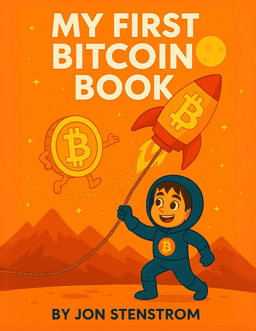
Give your kids the language behind your family treasury
My First Bitcoin Book introduces 26 Bitcoin concepts with fun illustrations, designed for ages 3-8.
Get the Book