Pay Kids in Satoshis: The Hybrid Allowance System for Bitcoin Parents
We're parents sharing what we've learned, not financial advisors. Some links may pay a referral. Full disclosure.
Every parent I know has the same allowance argument. Tied to chores or not? $1 per year of age or flat rate? Cash or app? Three jars or one? The debate runs in circles because everyone's arguing about the structure and skipping the variable that actually compounds.
The unit. What is the allowance denominated in? Once I started asking that, the rest of the debate got smaller. We pay our kids partly in dollars (for the daily mechanics) and partly in satoshis (for the long stack). One teaches budgeting. The other teaches patience.
What's a satoshi, in one line for parents
A satoshi is the smallest unit of a bitcoin: 1/100,000,000 of a single BTC.1 Pennies are to dollars what sats are to bitcoin, except there are 100 million of them in a coin instead of 100. So a 5,000-sat gift sounds like a lot to a 7-year-old. (It feels bigger than “0.00005 BTC,” which is the same number written in adult.) Want the kid-friendly version? What are satoshis for kids breaks it down with examples.
The unit question nobody asks
Saving in dollars teaches one habit: stash more, faster, because the dollar quietly loses buying power every year. The implicit lesson is that money melts, so you have to chase yield to stay even. That's how most adults end up in “safe” mutual funds they don't understand.
Saving in a fixed-supply asset teaches a different habit. There are 21 million bitcoin, ever, by protocol consensus.2 Your slice doesn't shrink. So saving means keeping, not chasing. The kid learns that patience is a strategy, not a personality trait.
Both lessons matter. Kids still need to know how to budget a $5 weekly allowance for snacks and stickers. But the long-term stack should be in something that doesn't need defending against inflation. That's the hybrid system.
How a sats allowance actually works
The mechanics are simpler than they sound. You buy bitcoin in your own account (River and Strike both let you buy small amounts and stack sats over time).3 You set up a separate ledger per kid (a spreadsheet works fine). Every week or every milestone, you log a deposit in sats from your stack to the kid's line. The bitcoin stays in your custody until the kid is old enough to manage their own.
That last part trips people up. The kid doesn't need a wallet at age 7. You hold the keys. You show them the balance. You walk them through the price chart on Sunday. The custody stays with the parent until the teen years, exactly like a college fund.
For the daily allowance, Cash App Managed Accounts (ages 6-12) handles the dollar piece with parent oversight built in.4 For ages 13+, Cash App Sponsored Accounts let the teen actually buy bitcoin themselves with parent approval. (Full custody walkthrough in the Bitcoin savings account for child guide.)
The hybrid system: dollars for daily, sats for the treasury
Here's the split I run with my kids. Dollars for spend, sats for save. The dollar side teaches transactional money. The sats side teaches generational money. They live in separate buckets and serve different jobs.
- Daily/weekly: Dollar allowance through Cash App or cash. Real money for real choices: snacks, small toys, sticker books, the impulse buy at Target.
- Milestone gifts: Sats from your stack. Birthdays, lost teeth, finished a chapter book, helped a sibling without being asked. Tangible recognition in scarce money.
- The long stack: Parent-held sats accumulating in your treasury, earmarked per kid. This is the layer that compounds for 20 to 30 years.
The ratio doesn't have to be perfect. We do roughly 80% dollars and 20% sats by weekly value, with bigger sat lumps on milestones. The point is that both currencies show up in the kid's mental model from the start. (See the Bitcoin parent treasury system for how this fits into the broader family balance sheet.)
How much, by age
The classic rule is $1 per year of age per week. I think that's a reasonable floor for the dollar side. The sats side I treat differently: smaller, more symbolic, more tied to moments than weekly grind. A few rough numbers I use:
- Age 5: $5/week dollars. 1,000 sats per milestone (lost tooth, finished a book). About 5 milestones per year.
- Age 7: $7/week dollars. 2,500 sats per milestone. Birthday gift of 10,000 sats from grandparents if they're game.
- Age 10: $10/week dollars (split spend/save/give). 5,000 sats per milestone. Birthday gift of 25,000 sats.
- Age 13: Cash App Sponsored Account opens. They can buy their own sats now. Match what they save: every 1,000 sats they buy, you add 1,000.
The numbers shift with bitcoin's price. 5,000 sats is a few bucks at one price and a meaningful gift at another. That's a feature, not a bug. The kid learns the math of a fluctuating unit alongside the static one.
What to say when the kid asks “why did my sats go down?”
Their sats didn't go down. Their sats are exactly where they were last week. What moved was the dollar price of bitcoin, which is a different thing. This distinction is worth practicing because most adults conflate it too.
I tell my kids: “You still own 10,000 sats. The store of sats next to your bed is the same. The price tag in dollars went up or down, the way the price tag on a video game goes up or down. Your stuff didn't change.” That reframe takes about 30 seconds and it does most of the volatility work.
The deeper lesson, when they're ready, is that bitcoin's price in dollars wobbles short-term and trends up long-term, because the supply is fixed and demand generally grows. Past performance isn't a guarantee of future returns. (We say that out loud, even to a 9-year-old. Honesty about risk is part of the curriculum.)
Spend, Save, Give in the sats version
The Ron Lieber three-jar system (Spend, Save, Give) is a solid framework and it translates cleanly to sats with one tweak: the Save jar is for sats, not dollars. The Spend and Give jars stay in dollars because that's what the world transacts in.
- Spend ($): Daily, transactional. Burn it on the thing. Learn the trade-off.
- Save (sats): Long horizon. The asset that doesn't need to be defended against inflation. This is the jar that compounds for decades.
- Give ($): Whatever cause they pick. Dollars work fine for charity because most organizations still need them, though some accept bitcoin too.
Splitting the unit by purpose teaches a subtle thing: not all money is the same money. The dollar in the Spend jar and the sats in the Save jar serve different jobs. Adults forget this and try to use one tool for everything.
Tied to chores, or not?
Both schools work, honestly. Some research suggests tying allowance to chores teaches earning, while keeping it untied teaches budgeting without coercion.5 I've seen good kids come out of both camps.
We do it untied. The reason: I want chores to be part of being in this family, not a transaction. You take out the trash because you live here, not because you're owed $2. The allowance is a separate tool for teaching money skills, and we keep the two clean.
For the sats side, I tie it to milestones instead of weekly chores. A finished book, a kindness shown, a hard thing done. Sats reward growth, not labor. Dollars reward labor (we do paid extra-credit jobs above the baseline chores). It's a small distinction that does a lot of work over years.
Parent talking points
- “Why not just give them dollars and let them figure it out later?” Because money habits form early. Penn State Extension and Cambridge research both put the window for core financial habits around ages 5 to 7.6 By the time they're 12 you're working against patterns, not building them.
- “What if bitcoin goes to zero?” Possible. After 17+ years of running, the probability is low, but it's real. The sats portion is small relative to the rest of the family balance sheet (529, regular savings, retirement accounts). It's a learning tool and a long-term option, not the whole plan.
- “Isn't this gambling?” Not by my read. We're holding the asset for decades, not trading it. The kid never touches a price chart with intent to act. They see the chart the way they see the weather: it changes, you don't panic, you keep showing up.
- “What about taxes?” Gifts of bitcoin from parents to kids fall under the same annual gift exclusion as cash (currently $19,000 per recipient per year for 2025).7 For most families, the sats-allowance amounts are tiny relative to that limit. Talk to your accountant if you're structuring something larger.
Try this at home
The $5 sat gift (15 minutes, ages 6+). Open River or Strike. Buy $5 of bitcoin. Note the sat amount you got (it'll be a number with several thousand in it). Show your kid the number. Tell them it's theirs and you're holding it for them until they're older. Write it on a sticky note: “[Kid's name]'s starter sats: [number] sats, [date].” Tape it to the fridge.
Check the sat balance every quarter. The number stays the same. The dollar price next to it moves. That's the entire lesson, repeated quietly for years. Pair this with the teaching kids saving vs. spending two-jar system to cover both halves of the unit.
Materials: A River or Strike account, $5, a sticky note. Time: 15 minutes to set up. The rest happens on its own.
Sources
- Bitcoin.org, Vocabulary: Satoshi (smallest unit of bitcoin: 1/100,000,000 BTC)
- Nakamoto, Satoshi. Bitcoin: A Peer-to-Peer Electronic Cash System (2008); 21M cap defined by current Bitcoin Core consensus rules
- River Financial, River.com, and Strike, Strike.me (both support recurring small-amount BTC purchases for sats accumulation)
- Cash App (Block, Inc.), “Cash App Helps Families Build Healthy Financial Habits Together with New, Parent-Managed Accounts for Kids” (April 21, 2026); Sponsored Accounts (13+) support BTC and stock purchases with parent approval
- Lieber, Ron. The Opposite of Spoiled (Harper, 2015); see also T. Rowe Price, Parents, Kids & Money Survey
- Consumer Financial Protection Bureau, Money as You Grow: Help for Parents and Caregivers; Whitebread & Bingham (University of Cambridge), “Habit Formation and Learning in Young Children” (2013) (St. Louis Fed summary)
- IRS, Frequently Asked Questions on Gift Taxes (annual exclusion amount, 2025)
This site is created by a Bitcoin advocate and parent. It presents one perspective on money and financial education. Nothing here is financial advice. Bitcoin is volatile and you can lose money. Consult a licensed financial advisor before making investment decisions for your family.
Keep reading
The Bitcoin Parent Treasury: A System for Long-Term Family Wealth
Most parents save in dollars for a world that won't exist. The Bitcoin Parent Treasury is a four-layer system for building generational family wealth with sound money at the center.
Bitcoin Savings Account for Your Child
There's no 'Bitcoin savings account' at a bank. Here's what a Bitcoin savings plan for your kid actually looks like: recurring buys, hardware wallet custody, and cost basis tracking.
Teaching Kids About Saving vs. Spending
A hands-on lesson for teaching kids ages 6-9 the difference between saving and spending. Uses two jars, real coins, and a savings goal they pick themselves.
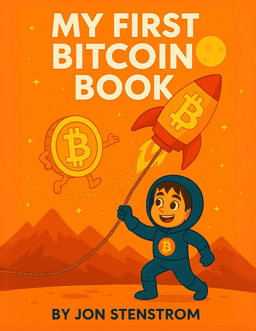
Build the worldview your treasury needs
My First Bitcoin Book helps kids learn the words behind saving, scarcity, self-custody, and sats.