Budgeting for Teens: What Your First Paycheck Should Teach You
We're parents sharing what we've learned, not financial advisors. Some links may pay a referral. Full disclosure.
Your first paycheck is the first time money feels real. Not allowance real. Real real. You worked actual hours, somebody cut you a check, and then you opened it and thought: wait, where did the rest go?
That gap between gross and net is your first economics lesson. And it hits harder than any textbook. The average teen earns about $13/hour.1 After taxes, that $13 becomes roughly $11. Every hour you work, about $2 vanishes before you touch it.
Your first paycheck: what just happened
Say you worked 40 hours at $12.50/hour. Gross pay: $500. But your check says $418. Three things took a bite:
- Social Security (6.2%): $31 goes to fund retirement payments for today's seniors. You won't see this money for decades.2
- Medicare (1.45%): $7.25 funds health care for people over 65.2
- Federal income tax (10%): Up to $50 on this check, depending on your W-4.3
That's before state taxes, which vary. The point: roughly 15-20% of your paycheck goes to the government before you see a dime. Our taxes guide breaks down where all of it goes.
The 4-bucket system
Most budgeting advice says “save 20%.” Fine. But save in what? A checking account? A savings account paying 0.5%? That matters more than the percentage.
Michael Saylor, the CEO of Strategy (formerly MicroStrategy), uses a framework that sorts money into four buckets based on time horizon.4 Adapted for a teen with a first job, it looks like this:
- Spending: Money you need in the next 1-3 months. Gas, food, going out. Cash or checking account. This is your working capital.
- Saving: Money you're storing for 1-4 years. This should be in something that at least keeps pace with inflation, not a regular savings account losing purchasing power.
- Investing: Money you won't touch for 4+ years. Index funds, Bitcoin, things that have a shot at growing faster than inflation. Saylor calls this your “balance sheet” and says it should hold “scarce desirable property.”4
- Speculation: Money you're genuinely OK losing. Meme stocks, crypto tokens, sports bets. 5% of your money, max.4 The key: don't confuse this bucket with investing. Gambling dressed up as investing is how people go broke.
The real insight is separating your “P&L” (the money you earn) from your “balance sheet” (the money you keep).4 Your job is to maximize what you earn. The 4 buckets tell you what to do with it once you have it.
Checking accounts: your spending bucket
A checking account is for spending money. That's it. Saylor recommends keeping roughly 12 weeks of expenses in your checking account, enough to cover your near-term bills.4 Everything above that is sitting there losing value.
The average monthly maintenance fee on a checking account is $13.95.5 That's $167/year just for the privilege of holding your own money. If you're earning $13/hour, the bank is charging you nearly 13 hours of work per year in fees alone. Look for fee-free accounts (37% of checking accounts now have no monthly fee).5 Our how banks work guide explains what the bank does with your money while it sits there.
Where does the rest go?
Here's the uncomfortable math. The average savings account pays about 0.5% interest.6 Prices have been climbing 3-7% per year.7 That means every dollar in a savings account is quietly losing 2.5-6.5% of its purchasing power annually. You're going backwards.
Options that at least put up a fight against inflation:
- High-yield savings accounts: 4-5% APY right now. Better than 0.5%, but still barely matching inflation. Good for money you need within 1-2 years.
- Index funds: The S&P 500 has returned roughly 10% annually over long periods.8 Better for money you won't touch for 4+ years. Real risk of short-term losses though.
- Bitcoin: The highest-performing asset over any 4-year holding period in the last decade. Also the most volatile. Saylor argues it's the best long-term store of value because of its fixed supply of 21 million.4 Our Bitcoin talk for teens covers the full case.
For a deeper comparison of all these options, see our best ways to save breakdown.
Why “save 20%” is incomplete advice
The standard budgeting rule (50% needs, 30% wants, 20% savings) is a fine starting point. But it never answers the follow-up question: save 20% in what form?
$1,000 saved in a regular savings account at age 18 will buy roughly $500 worth of stuff by age 28, if inflation runs at its historical average of about 7%.7 Your account balance still says $1,000 (maybe $1,050 with interest). But the things you want to buy cost twice as much. The number didn't change. The purchasing power did.
That's why Saylor separates the “form” of savings from the “habit” of saving.4 The habit matters. But a good habit with the wrong vehicle still loses. A dentist making $200K who sweeps excess cash into a savings account is watching that money melt. The same dentist sweeping it into scarce property is building generational wealth.4 Same effort, wildly different outcome.
Building credit early
Your credit score is a number from 300 to 850 that determines what you can rent, borrow, and sometimes even who'll hire you. Starting early gives you a longer credit history, which is 15% of your score.9
Two ways to start before 18:
- Authorized user: A parent adds you to their credit card. You get a card with your name on it, their payment history shows up on your credit report, and the minimum age varies by issuer (American Express and U.S. Bank allow it at 13, Discover at 15).10
- Secured credit card: Available once you turn 18. You put down a deposit (say $200), and that becomes your credit limit. You need to show independent income to qualify under the CARD Act.11
Why bother? Because at 18 you'll want to rent an apartment, and landlords check credit scores. A two-year head start as an authorized user means you show up with a real history instead of a blank file. Our credit and debt guide covers the full picture, including why the system rewards smart borrowers.
The hourly rate test
Naval Ravikant has a simple filter for every purchase: convert the price to hours of your life.12 If you earn $13/hour and take home $11 after taxes, a $60 video game costs you 5.5 hours of work. Not $60. Five and a half hours of your life that you can never get back.
Naval took this further. He set an “aspirational hourly rate” for himself ($5,000/hour, even before he had money) and refused to do anything that paid less.12 For a teen, the version is simpler: before you buy something, divide the price by your after-tax hourly wage. If the answer makes you flinch, that's data.
This math also exposes why renting out your time (hourly work) has a ceiling. You can only work so many hours. Naval's point: true wealth comes from owning things that earn while you sleep.12 At 16, your job is to learn, earn, and start thinking about which bucket each dollar belongs in. At 25, the goal shifts to owning equity, not just trading hours.
Try this at home: first paycheck simulator
Ages: 13+. Time: 15 minutes. Materials: $100 in cash (or play money), 4 envelopes, a marker.
- Label four envelopes: Spend, Save, Invest, Speculate.
- Hand your teen $100. Tell them: “You just got paid. But first, the government takes its cut.” Remove $18 (FICA + income tax on a teen's wages). They now have $82 to split.
- Ask them to divide the $82 across the four envelopes. No right answer. The conversation about why they split it that way is the whole point.
- After they split it, ask: “The Spend envelope buys stuff this month. The Save envelope loses 3-7% of its value every year if it just sits in cash. What would you put the Save money in to stop it from melting?”
- For the Speculate envelope, ask: “If this money disappeared tomorrow, would you be OK?” If not, move some of it to another envelope.
- Repeat monthly as they earn real paychecks. Track how the splits change as they learn what each bucket actually does.
Sources
- U.S. Bureau of Labor Statistics, Employment and Unemployment Among Youth (teen wage data; average hourly earnings for workers aged 16-19)
- Internal Revenue Service, Topic No. 751: Social Security and Medicare Withholding Rates (FICA rates: 6.2% Social Security, 1.45% Medicare)
- Internal Revenue Service, Federal Income Tax Rates and Brackets (2025 tax year: 10% on taxable income up to $11,925 for single filers)
- Saylor, Michael. Various interviews and public remarks on capital allocation, including Bitcoin for Everybody (Saylor Academy, 2024); 4-bucket framework, P&L vs balance sheet, 12-week checking account rule, sweep-into-Bitcoin strategy
- MoneyRates.com, Checking Account Fee Survey (February 2025; average monthly maintenance fee: $13.95)
- Federal Deposit Insurance Corporation, National Rates and Rate Caps (average savings account yield)
- U.S. Bureau of Labor Statistics, Consumer Price Index (historical inflation data; cumulative purchasing power erosion)
- S&P Dow Jones Indices, S&P 500 Index Performance (historical average annual return ~10%)
- Consumer Financial Protection Bureau, What Is a Credit Score? (score components: payment history, credit utilization, length of history)
- Experian, Minimum Age for Authorized Users by Credit Card Issuer
- Discover, Credit Cards for Teens: What to Know (CARD Act requirements for applicants 18-20)
- Ravikant, Naval. The Almanack of Naval Ravikant (2020); aspirational hourly rate, renting time vs. owning equity
This site is created by a Bitcoin advocate and parent. It presents one perspective on money and financial education. Nothing here is financial advice. Bitcoin is volatile and you can lose money. Consult a licensed financial advisor before making investment decisions for your family.
Keep reading
How to Explain Taxes to Kids
Taxes fund roads and schools. But governments also change the rules whenever they want. The Sardinian yacht tax, the colonial tobacco police state, and why property taxes mean you never truly own your house.
Teaching Kids About Credit and Debt
Credit card debt is a trap. But the fiat system actually rewards smart borrowers and punishes patient savers. Here's how to explain both sides to your kids.
How to Talk to Your Teenager About Bitcoin
Teenagers are allergic to lectures. Here's how to have a Bitcoin conversation with your teen that doesn't end in eye rolls. Includes a $20 experiment.
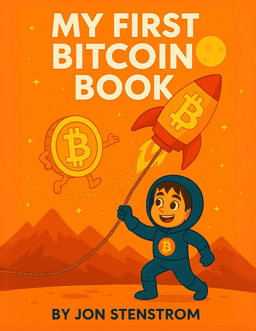
Give your kids the language behind your family treasury
My First Bitcoin Book introduces 26 Bitcoin concepts with fun illustrations, designed for ages 3-8.
Get the Book