How Much Bitcoin Do You Need to Retire as a Parent?
We're parents sharing what we've learned, not financial advisors. Some links may pay a referral. Full disclosure.
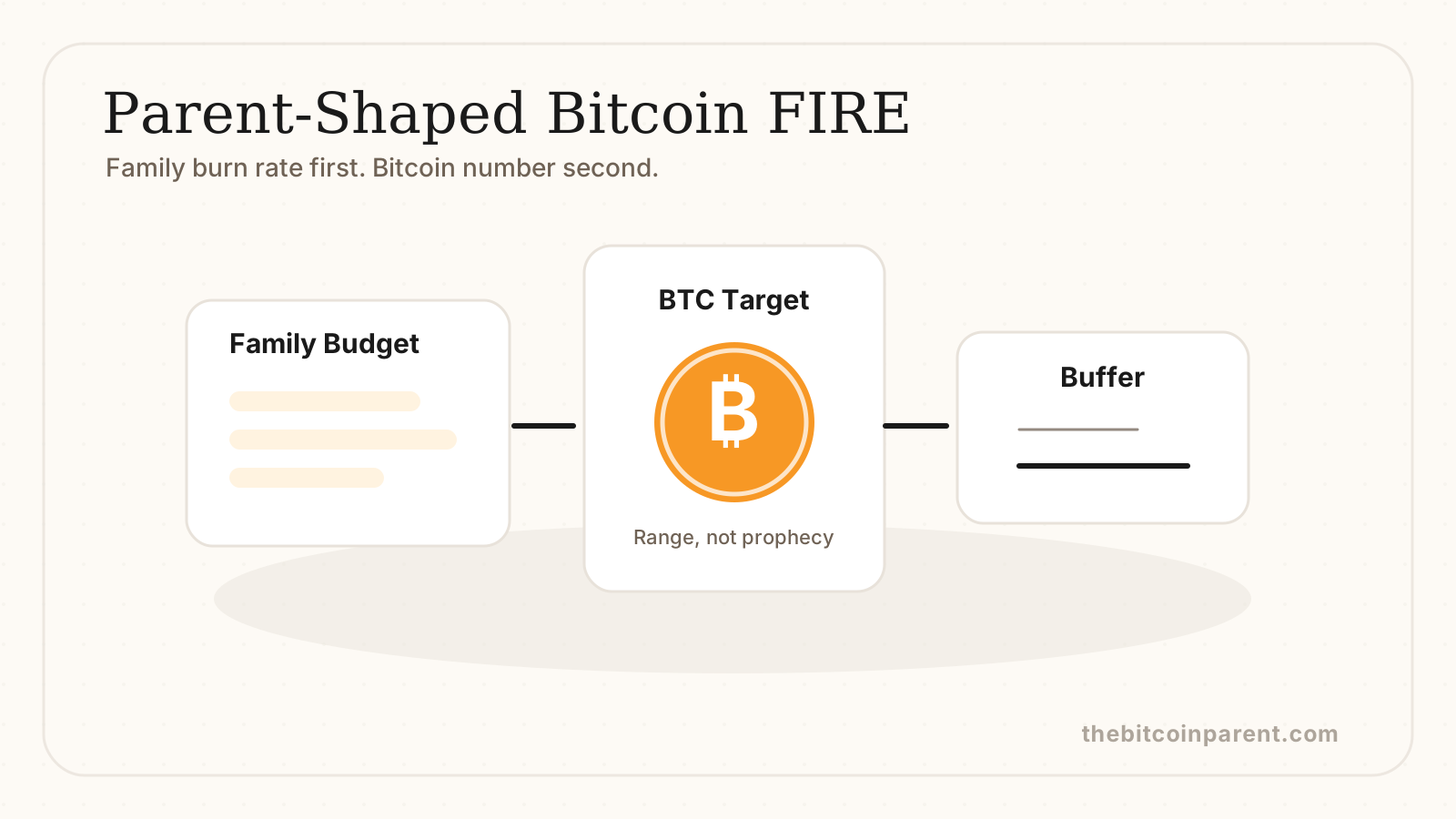
The wrong question is “what coin number lets me quit forever?” The better question is: how much scarce savings does your family need so work becomes optional, your kids are protected, and you are not forced to sell Bitcoin during the worst week of the cycle?
That is the parent-shaped version of Bitcoin FIRE. Not escape. Stewardship. A family treasury big enough to buy back time, survive bad markets, train your kids, and still leave something behind.
The short answer: at a future price of $1,000,000 per bitcoin, many middle-class families are probably talking about a range of roughly 1 to 4 BTC, depending on spending, risk tolerance, child costs, and whether they use a conservative 4% withdrawal rule or a more aggressive Bitcoin-FIRE assumption. The exact number is less important than the method.
Quick answer: how much BTC to retire?
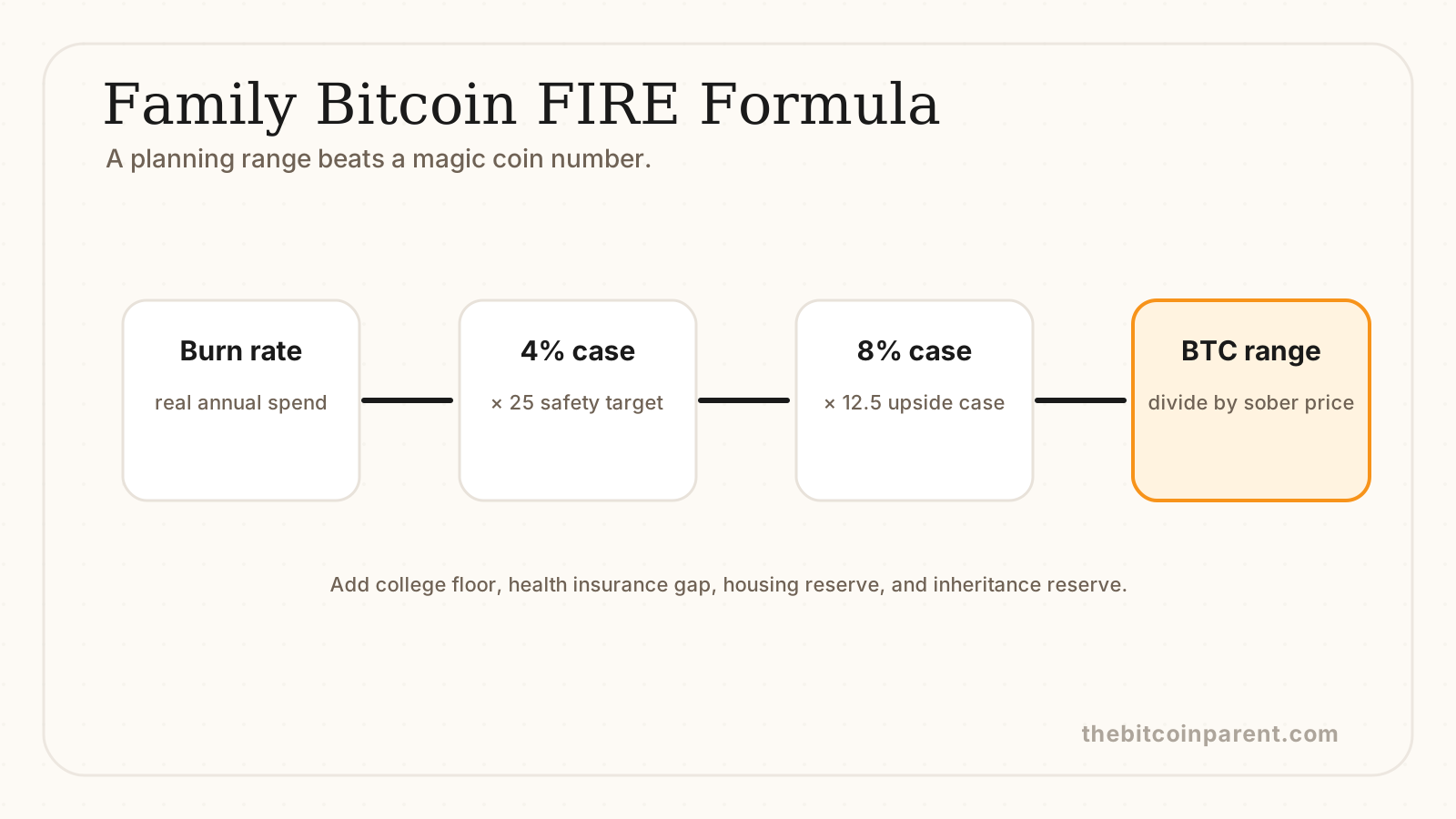
For a parent, the practical range is usually annual family spending × 12.5 to 25, divided by your conservative future BTC price. Then add child-specific reserves for education, healthcare, housing, and inheritance.
Example: a family spending $90K/year needs about $1.125M to $2.25M before child reserves. At $1M/BTC, that is roughly 1.1 to 2.3 BTC before the parent buffer.
Start with annual family spending
Traditional FIRE starts with annual expenses, not net worth envy. If your family spends $80,000 per year, the math starts there. If your family spends $140,000 per year, the math starts there. Retirement is not priced in Bitcoin first. It is priced in household burn rate.
The classic FIRE rule says you need about 25x annual expenses. That comes from the 4% safe withdrawal rate framework, usually traced back to the Trinity study and similar retirement-withdrawal research. In plain English: a $1,000,000 portfolio can support about $40,000 of first-year annual spending under the 4% rule, adjusted for inflation after that.1
Formula:
Annual family spending ÷ withdrawal rate = retirement portfolio target
The 4% case vs. the 8% Bitcoin case
The 4% case is the sober baseline. It assumes you are planning like a normal retiree using traditional safe-withdrawal math. It is not Bitcoin-specific. It is the “do not blow up the family” number.
Some Bitcoin-FIRE thinkers use a more aggressive 8% withdrawal assumption because they expect Bitcoin purchasing power to keep rising as adoption grows. Mathematically, that cuts the target in half: instead of 25x annual expenses, you need 12.5x.
I would not build a parent retirement plan on the 8% case alone. A single person can sleep in a van, move countries, or take a high-variance bet. A parent has dependents. Use 4% as the safety case, 8% as the upside case, and keep enough flexibility that you are not forced to sell into a drawdown.
What the numbers look like at $1M/BTC
Using a $1,000,000 future bitcoin price as a planning scenario, here is the rough range:
- $60,000/year family spend: $1.5M target at 4% = 1.50 BTC. $750K target at 8% = 0.75 BTC.
- $90,000/year family spend: $2.25M target at 4% = 2.25 BTC. $1.125M target at 8% = 1.13 BTC.
- $120,000/year family spend: $3M target at 4% = 3.00 BTC. $1.5M target at 8% = 1.50 BTC.
- $180,000/year family spend: $4.5M target at 4% = 4.50 BTC. $2.25M target at 8% = 2.25 BTC.
If Bitcoin is $500,000 instead, double the BTC number. If Bitcoin is $2,000,000, cut the BTC number in half. Do not worship the $1M scenario. It is a ruler, not a prophecy.
The parent adjustment: retirement is not just your spending
A normal FIRE calculator asks one adult question: “How much do I spend?” Parents need a wider lens. Your family treasury has to handle your own spending plus child-specific obligations and generational goals.
Add these to the model:
- Child lifecycle costs: braces, sports, travel, tutoring, cars, launch money, and the teenage grocery bill nobody warns you about.
- Education floor: 529, cash, scholarships, trade school, community college, or Bitcoin. Decide what you are actually promising before you call yourself FI.
- Healthcare and insurance: especially if you retire before Medicare age. A family plan can wreck pretty spreadsheet math.
- Housing resilience: repairs, property taxes, moving costs, and the option to geo-arbitrage if your state becomes hostile or too expensive.
- Inheritance reserve: the part you do not intend to spend at all. This is the difference between personal FIRE and a family Bitcoin treasury.
A simple family Bitcoin retirement formula
- Find your annual family baseline. Use real spending from the last 12 months. Do not guess.
- Calculate the 4% safety number. Annual spending × 25.
- Calculate the 8% upside number. Annual spending × 12.5.
- Add parent-specific obligations. College floor, healthcare gap, housing reserves, and any inheritance reserve you refuse to spend.
- Divide by your conservative Bitcoin price assumption. Not your dream price. The price where the plan still works if the cycle takes longer than expected.
Example: a family spending $90,000/year has a $2.25M 4% target and a $1.125M 8% target. Add a $150,000 education and launch reserve, and the range becomes $1.275M to $2.4M. At a $1M bitcoin price, that is roughly 1.3 to 2.4 BTC. At a $500K bitcoin price, it is 2.6 to 4.8 BTC.
That range is more useful than a fake-precise answer. It tells the family whether they are early, close, or already playing defense.
Build the system before chasing the number
A BTC target is useless without recurring buys, custody, emergency cash, and spouse instructions. Start with the Bitcoin Parent Treasury system, lock down custody with the Family Bitcoin Custody Starter Kit, and use Resources for current tools.
Be careful with TAM math
Bitcoin valuation threads love total-addressable-market math: global wealth, bonds, real estate, gold, equities, fiat savings, all competing for a fixed 21 million bitcoin supply. Useful directionally. Dangerous if you turn it into a retirement promise.
Example: if Bitcoin eventually captured 25% of a $1 quadrillion global store-of-value pool, the implied network value would be $250 trillion. Divide that by 21 million bitcoin and you get roughly $11.9M per BTC. A more modest $1M bitcoin scenario would still be enormous: about a $21 trillion network value, or roughly 2.1% of that same $1 quadrillion pool.
The point is not that one number is right. The point is that parents should separate directional conviction from household planning. TAM math belongs in the upside case. Your family budget belongs in the sober case.
The four-year stacking sprint
One useful Bitcoin-FIRE idea is the front-loaded sprint. Instead of vaguely stacking forever, choose a four-year window and make it a family project: reduce waste, increase income, automate buys, lock down custody, and build the adult treasury first.
Four years matters because Bitcoin moves in halving-length eras. It also maps well to parent life. Sprint when your baby is born, and by kindergarten you have a real treasury foundation. Sprint when your kid is 7, and by middle school the family balance sheet looks different. Sprint when your teen starts working, and they watch low time preference in real time instead of hearing a lecture about it.
The sprint is not permanent austerity. It is a season of focused saving so compounding has something meaningful to work with. After that, you can ease off without starting from zero.
What if Bitcoin crashes after you retire?
This is the part most bullish retirement content skips. Bitcoin can fall 50%, 70%, or more. If that happens in the first few years after you quit, you have sequence-of-returns risk: you are selling more sats at the worst possible time to fund the same family expenses.
The parent answer is flexibility:
- Keep 12-24 months of fiat operating cash so you are not forced to sell Bitcoin.
- Keep marketable skills warm: consulting, part-time work, advising, contracting.
- Cut discretionary spending during drawdowns instead of pretending volatility is fake.
- Geo-arbitrage if your cost structure is the problem, not your stack.
- Delay large one-time withdrawals until after the market recovers, if possible.
This does not make Bitcoin safe. It makes the family harder to break.
Borrowing vs. selling later
A large enough Bitcoin treasury eventually creates a new question: sell coins, borrow against them, or earn income elsewhere and leave the stack untouched? Wealthy families have long borrowed against trophy assets instead of selling them. Bitcoin may become part of that pattern.
But Bitcoin-backed lending is not magic. It adds counterparty risk, margin-call risk, rate risk, and behavioral risk. A parent borrowing against the family stack for a true bridge need is different from a parent levering up because the chart looks good. If you use debt, size it so a brutal drawdown does not liquidate the asset you were trying to preserve.
Where this fits in the Bitcoin Parent Treasury
This article is Layer 1: the adult treasury. Before you optimize your kid's sat allowance or compare Bitcoin to a 529, you need your own family balance sheet pointed in the right direction. The adult stack funds resilience. The kid layer teaches habits. The legal layer handles inheritance.
If you are new, start with the Bitcoin Parent Treasury system. If you are thinking about tax wrappers, read the guide to Bitcoin in a Roth IRA without giving up self-custody. If you are building the kid layer, read the Bitcoin savings account for a child guide. For current exchange, wallet, and custody links, keep the Resources page open next to the plan.
Bottom line
If your family spends $60K-$120K/year, a rough Bitcoin retirement target at $1M/BTC is about 0.75 to 3 BTC, depending on whether you use the aggressive 8% case or the conservative 4% case. Add education, healthcare, housing, and inheritance goals, and many families land closer to 1 to 4 BTC.
But the better answer is behavioral: know your burn rate, stack intentionally for a defined window, custody properly, keep enough cash to survive volatility, and teach your kids why the family is doing it. The goal is not to quit work and disappear. The goal is to become harder to force.
Sources
- Trey Sellers, “Bitcoin is FIRE Friendly”, explaining FIRE, the 25x annual-expense rule, the 4% safe withdrawal rate, and the Trinity study framing.
- Wade Pfau, overview of Trinity study retirement-withdrawal findings, archived October 2010.
- Investor.gov, compound interest calculator, for checking long-term compounding assumptions.
- IRS, Roth IRAs, for official tax-wrapper rules and limitations.
This site is created by a Bitcoin advocate and parent. It presents one perspective on money and financial education. Nothing here is financial advice. Bitcoin is volatile and you can lose money. Consult a licensed financial advisor before making investment decisions for your family.
Keep reading
The Bitcoin Parent Treasury: A System for Long-Term Family Wealth
Most parents save in dollars for a world that won't exist. The Bitcoin Parent Treasury is a four-layer system for building generational family wealth with sound money at the center.
Bitcoin in a Roth IRA Without Giving Up Self-Custody
How to put Bitcoin in a Roth IRA while still holding the keys yourself, and why a custodial Bitcoin IRA quietly defeats the point.
Bitcoin vs. 529 Plan for Your Child
A side-by-side comparison of Bitcoin savings and 529 plans for your kid. Tax benefits, flexibility, risk, and why a lot of families end up using both.

Teach the next steward of your family treasury
My First Bitcoin Book is the easiest way to make Bitcoin language normal at home. 26 concepts, fun illustrations, designed for ages 3-8.
Buy on Amazon