How to Buy Bitcoin for Your Child
We're parents sharing what we've learned, not financial advisors. Some links may pay a referral. Full disclosure.
I bought my first Bitcoin on Cash App in 2019. Took about 90 seconds. Buying was easy. Figuring out where to keep it, how much to buy, and what happens when your kid turns 18 and you hand them the keys took years.
To buy Bitcoin for your child, open an account on a Bitcoin-focused exchange like River (0% fees on recurring buys) or Strike, set up a weekly auto-purchase of $10-50, and withdraw to a hardware wallet once you've accumulated $200-500+. Before the first meaningful withdrawal, use the family custody starter kitto choose the right parent setup. Track your cost basis for tax purposes, because when you eventually gift the Bitcoin to your child, that basis transfers to them.6
Treat this as Layer 1 or Layer 2 of your family Bitcoin treasury, not as a trading account for a kid. The first job is boring: buy consistently, avoid exchange risk as the balance grows, and document what your family owns.
Start here before you buy more than a test amount
Use the Resources page for the current River, Strike, wallet, and custody-tool stack, then map the purchase into the Bitcoin Parent Treasury system.
Which exchange should parents use to buy Bitcoin?
You're buying Bitcoin in your name, on behalf of your kid. Minors can't open accounts on any major exchange.1 So you need an account first. (More on why in our can minors own Bitcoin guide.)
My recommendations, ranked by how much I trust them for long-term holding:
- River (0% fees on recurring buys,2 auto-withdrawal to your own wallet, Bitcoin-only). Best for parents who want a set-it-and-forget-it approach.
- Strike (fees around 0.3%,3 simple interface, supports auto-buy). Great if you want to stack sats on a schedule without thinking about it.
- Cash App (spread around 1.5-2.5%4). Fine for getting started. Not ideal for large amounts or long-term storage.
- Coinbase (largest US exchange, decent security, but sells hundreds of altcoins). More buttons to push than you need if Bitcoin is all you want.
If your goal is a long-term savings plan for your kid, River or Strike are the cleanest options. They don't try to sell you 400 other tokens.
How should parents set up recurring Bitcoin purchases?
Don't try to time the market. I promise you won't be good at it. (I wasn't.)
Set up a weekly or monthly auto-buy. $10/week, $25/month, $50/month, whatever fits your budget. This is called dollar-cost averaging (DCA). You buy the same dollar amount on a schedule, regardless of price. When Bitcoin is down, you get more sats. When it's up, you get fewer. Over years, it smooths out.
River and Strike both let you set this up in about 2 minutes. Link your bank account, choose your amount, pick your frequency. Done. If you want the full playbook on amounts and frequency, see our Bitcoin savings plan guide.
Where should I store Bitcoin I'm holding for my child?
This is the most important decision and the one most parents skip.
- Leave it on the exchange (easiest, least secure). Fine for small amounts under $500. If the exchange gets hacked or goes bankrupt (remember FTX lost $8 billion in customer funds5), your Bitcoin is gone.
- Hardware wallet (strong security, requires some setup). A Trezor device stores your keys offline. Nobody can hack what isn't connected to the internet. This is what I recommend for anything you're holding long-term for your kids. (Full setup walkthrough in our wallet guide.)
- Multisig custody (advanced, more redundancy). Services like Unchained let you set up 2-of-3 multisig vaults. You hold 2 keys, they hold 1 as backup. Overkill for $50/month, but worth considering once you've stacked a meaningful amount.
What are the tax rules for buying Bitcoin for a child?
The IRS considers Bitcoin property, not currency.6 When you eventually transfer it to your kid or sell it, there are tax implications.
- Gifting: For 2026, you can gift up to $19,000 per recipient before a federal gift tax return is generally required.7 Most parents won't hit this with Bitcoin savings.
- Cost basis transfers: When you gift Bitcoin, your cost basis (what you paid) transfers to your kid.6 If you bought at $30,000 and they sell at $100,000, they owe capital gains on the $70,000 difference.
- UTMA/UGMA accounts: Some parents use custodial accounts. The asset belongs to the child, but you manage it until they reach the age of majority (18 or 21, depending on your state).8
Talk to a tax professional if you're stacking serious amounts or transferring ownership formally. For small recurring buys, the main thing is to keep clean records.
What does a real Bitcoin savings plan look like?
I buy on River with a recurring weekly purchase. Once a quarter, I withdraw to a hardware wallet. I keep a spreadsheet with dates, amounts, and prices (cost basis tracking). It takes about 5 minutes a quarter.
Saylor's framing resonates here: “You want to fix your family? Give them an endowment that'll last forever.”9 That's the long game. The Bitcoin is technically in my name. When my kids are old enough to understand custody and responsibility (I'm thinking 16-18), I'll transfer it to wallets they control. Until then, I don't want a teenager with a $20,000 hot wallet and zero impulse control.
How do I explain Bitcoin buying to my kid?
- “Why don't you just put the money in a bank?” I do that too. But bank savings accounts earn about 0.01-4.5% interest. I think Bitcoin might do better over 15+ years. It's a bet, not a guarantee. (Here's how banks actually work if they want the full picture.)
- “How much Bitcoin do I have?” Right now, [X] sats. That's [X] dollars at today's price. But the dollar amount will bounce around a lot. What matters is the number of sats, because that never changes.
- “Can I spend it?” Not yet. This is long-term savings. We'll talk about when it makes sense to use it when you're older.
Try this at home
First purchase together (15 minutes, ages 10+). Sit down with your kid and buy $5 of Bitcoin together. Use Cash App or Strike (both have simple interfaces). Walk them through each screen. Show them the order, the fees, the confirmation. Then pull up a Bitcoin block explorer (mempool.space) and find the transaction together. It makes it real.
Materials: A phone, $5, a Cash App or Strike account. Time: 15 minutes.
Sources
- FinCEN, Money Services Business Definition (KYC requirements for exchanges)
- River Financial, What Is Dollar-Cost Averaging Bitcoin? (zero-fee recurring orders)
- Strike, Strike Fee Schedule
- Cash App, Cash App bitcoin fees
- Reuters, “How FTX Collapsed” (Nov 2022)
- IRS, Frequently Asked Questions on Virtual Currency Transactions
- IRS, Frequently Asked Questions on Gift Taxes (2025 and 2026 annual exclusion: $19,000)
- Uniform Law Commission, Uniform Transfers to Minors Act
- Saylor, Michael. Interview with Peter Voogd, discussing Bitcoin as a generational endowment
This site is created by a Bitcoin advocate and parent. It presents one perspective on money and financial education. Nothing here is financial advice. Bitcoin is volatile and you can lose money. Consult a licensed financial advisor before making investment decisions for your family.
Keep reading
Should I Buy Bitcoin for My Child?
An honest look at buying Bitcoin for your kid. The case for it, the risks, and how to think about it as a parent.
How to Set Up a Bitcoin Wallet for Your Kid
Exchange wallets, mobile wallets, hardware wallets. Which one to use for your kid's Bitcoin, when to upgrade, and the seed phrase talk every parent needs to have.
Bitcoin Savings Account for Your Child
There's no 'Bitcoin savings account' at a bank. Here's what a Bitcoin savings plan for your kid actually looks like: recurring buys, hardware wallet custody, and cost basis tracking.
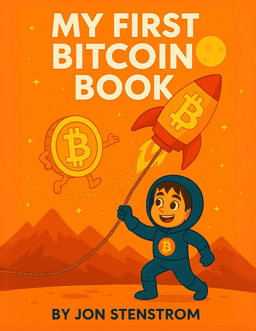
Teach the next steward of your family treasury
My First Bitcoin Book is the easiest way to make Bitcoin language normal at home. 26 concepts, fun illustrations, designed for ages 3-8.
Buy on Amazon