Teaching Economics to Homeschoolers
Most economics curricula are built for college freshmen. Dense textbooks, abstract graphs, zero connection to anything a 7-year-old cares about. You can do better at your kitchen table.
Teaching economics to homeschoolers works best when you organize by age (5-7 for foundation concepts like scarcity and trade, 8-10 for supply and demand, 11-13 for real-world application), keep sessions to 15-20 minutes, and use hands-on activities with household items instead of textbooks.
Why economics belongs in your homeschool curriculum
Economics is mostly about choices. Stocks and GDP are downstream of that. Every time your kid decides between spending their allowance now or saving for something bigger, they're doing economics. They just don't know it yet.
The Council for Economic Education found that only 25 states require any economics course in high school, and most of those are a single semester.1 Homeschool families can start years earlier with concepts that stick because they're tied to real decisions, not worksheets.
The goal here is to give your kids a mental model for how the world works: scarcity, trade-offs, incentives, value. Not to produce tiny Warren Buffetts. These concepts show up everywhere, from the grocery store to the playground.
What economics concepts to cover by age
Ages 5-7: Foundation concepts
Keep it concrete. At this age, everything needs to be something they can touch, see, or do.
- Wants vs. needs. Food is a need. A toy is a want. Practice sorting real items from around the house into two piles.
- Scarcity. There isn't enough of everything for everyone. Use beans or coins to make this tangible (give them 10 beans, price items at 3-5 beans each, watch them choose). Our scarcity activity walks through this step by step.
- Trade. Before money existed, people swapped things. Let siblings trade snacks or toys to feel how barter works (and why it's annoying).
- Saving vs. spending. Two jars: spend now, save for later. Let them practice with real coins each week. The two-jar activity makes this concrete.
Ages 8-10: Building blocks
They can handle cause and effect now. Start connecting dots.
- Supply and demand. If everyone in the family wants the last cookie, what happens to its “price”? Run a simple auction with household items.
- Opportunity cost. If you spend your $5 on candy, you can't spend it on a book. Every choice has a cost, even if you don't see it.
- What is money? Where it came from, why gold worked, why paper replaced it, and what gives money value (hint: trust). The history of money guide covers the full timeline.
- Inflation. Why Grandma's candy bar cost a nickel and yours costs $2. Use the inflation explainer as a companion lesson.
- Producers and consumers. Set up a mini lemonade stand (even a pretend one). Who makes the product? Who buys it? What determines the price?
Ages 11-13: Real-world application
Now they can handle abstractions. Push toward real decisions and current events.
- Interest and debt. Lend them $5 at 10% interest for a week. They'll remember the concept when they owe you $5.50.
- Budgeting. Give them a monthly budget for a real category (school supplies, snacks, entertainment). Let them manage it and live with the consequences.
- Different kinds of money. Gold, dollars, Bitcoin. What makes each one work? What are the trade-offs? The Bitcoin explainer for kids fits here.
- Taxes. When they earn money (chores, a small business), take 20% for the “family tax.” Watch how fast they develop opinions about government spending.
- Entrepreneurship. Help them start something small. Selling drawings, a bake sale, a lawn service. Real economics in real time.
Weekly homeschool economics schedule
This is meant to be light. 2-3 sessions per week, 15-20 minutes each. Economics shouldn't feel like a separate subject. It should weave into the day. The CFPB recommends integrating financial concepts across subjects rather than teaching them in isolation.2
- Monday: Concept day (15 min). Introduce one idea. Read about it together, discuss it, define it in their own words. Write the definition on an index card for their “economics dictionary.”
- Wednesday: Activity day (20 min). A hands-on exercise tied to the week's concept. Sorting, trading, budgeting, auctioning, counting. Use stuff from around the house. Our 6 financial literacy activities are designed for exactly this slot.
- Friday: Real-world connection (10 min). Find the concept in the wild. At the grocery store, in a news story, during allowance time. “Hey, remember what we learned about supply and demand? Look at what happened to egg prices.”
Best homeschool economics resources
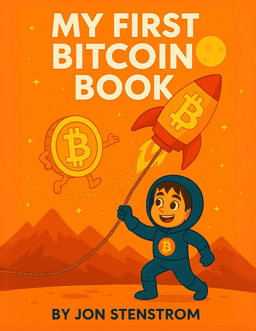
- My First Bitcoin Book (ages 3-8). Covers 26 Bitcoin and money concepts with illustrations kids enjoy. Good for the “what is money” and “scarcity” units.
- Whatever Happened to Penny Candy? by Richard Maybury (ages 10+). The best intro to economics for older kids. Written as letters from an uncle to his nephew.
- The Tuttle Twins series (ages 5-11). Story-based introductions to economic principles. Kids actually read these voluntarily.
- Next Gen Personal Finance (NGPF) free resources. Originally built for high school teachers, but the simulations and games work well adapted for advanced homeschool students ages 11+.3
- Real money. Honestly, the best curriculum is giving your kid an allowance and letting them make mistakes with it. A $5 bad purchase teaches more than 5 worksheets.
Where Bitcoin fits in your economics unit
Bitcoin fits naturally into several spots: when you teach scarcity, when you cover the history of money, when you discuss inflation. You don't need to make it the centerpiece. Just let it show up as one example of how money can work.
The Bitcoin lesson plan for elementary students slots right into your Wednesday activity day. Takes about 30 minutes and uses dried beans.
How to handle common parent concerns
- If they ask “Why do I need to learn this?” Because every single day, you make choices about money, time, and stuff. Economics is just the name for understanding those choices.
- If they find it boring: Shrink the sessions. 10 minutes with a real activity beats 30 minutes of explaining. If they're running a pretend store with beans, they're learning economics whether they realize it or not.
- If you feel unqualified: You already teach economics every time you say “we can't buy that right now.” You're just putting names on concepts they already encounter. Research from the University of Wisconsin found that parents who discuss money decisions out loud with kids produce measurably better financial outcomes than formal classroom instruction alone.4
Sources
- Council for Economic Education, Survey of the States: Economic and Personal Finance Education in Our Nation's Schools (2024)
- Consumer Financial Protection Bureau, Youth Financial Education Resources
- Next Gen Personal Finance, Free Financial Education Curriculum
- Consumer Financial Protection Bureau, Money as You Grow: Help for Parents and Caregivers
- Jump$tart Coalition for Personal Financial Literacy, National Standards in K-12 Personal Finance Education
- National Endowment for Financial Education, Financial Education Research Projects
This site is created by a Bitcoin advocate and parent. It presents one perspective on money and financial education. Nothing here is financial advice. Bitcoin is volatile and you can lose money. Consult a licensed financial advisor before making investment decisions for your family.
Keep reading
Financial Literacy Curriculum for Homeschool
A complete, age-sequenced financial literacy curriculum for homeschool families. Four units from money basics to budgeting, with hands-on activities and a weekly schedule.
Bitcoin Lesson Plan for Elementary Students
A ready-to-use lesson plan for teaching elementary-age kids about Bitcoin. Includes discussion questions, a hands-on activity, and a take-home conversation starter.
6 Financial Literacy Activities for Kids
Six hands-on financial literacy activities for kids ages 6-9. Each takes 10-20 minutes and uses stuff you already have: coins, beans, jars, paper, markers.
Give your kids the language behind your family treasury
My First Bitcoin Book introduces 26 Bitcoin concepts with fun illustrations, designed for ages 3-8.
Get the Book