Bitcoin Lesson Plan for Elementary Students
This is a ready-to-use lesson plan for teaching elementary-age kids (6-10) about Bitcoin. It takes about 30 minutes and requires stuff you already have in your house. No screens needed for the activity portion.
A Bitcoin lesson plan for elementary students should cover three things in 30 minutes: a discussion about what money is, a hands-on scarcity activity using 21 beans (representing all the Bitcoin that will ever exist), and a wrap-up connecting fixed supply to why Bitcoin is different from dollars.
What this lesson covers and who it's for
- Topic: What is money, and what makes Bitcoin different?
- Ages: 6-10 (adjust language for younger/older)
- Time: 25-30 minutes
- Materials: 21 dried beans (or coins, or small blocks), 2 jars, paper and markers
- Standards alignment: Covers financial literacy concepts recommended by the CFPB for K-5 students, including the relationship between scarcity and value.1
How to lead the money discussion (10 minutes)
Start by asking your kid(s) these questions. Let them answer before you explain.
- “What is money?” Most kids will say coins and bills. That's a good start. Explain that money is anything people agree has value and can be traded for things. For a kid-friendly breakdown, our history of money guide walks through shells, gold, paper, and digital money.
- “Has money always been paper?” Nope. People used to trade shells, salt, gold, even giant stones. Money changes over time.
- “What if someone could just make more money whenever they wanted?” This is the key question. Let them think about what would happen. (Answer: if there's too much, each piece becomes worth less.) The U.S. money supply grew from $4 trillion to over $21 trillion between 2000 and 2024.2
How to run the bean scarcity activity (15 minutes)
Put exactly 21 beans on the table. Explain: “These represent all the Bitcoin that will ever exist. 21 million. We can't make more. Nobody can.”
Saylor calls Bitcoin “the first absolutely scarce commodity in human history” because unlike gold, real estate, or stocks, nobody can manufacture more of it.3 That's what your beans represent: a supply that's permanently fixed.
- Divide the beans among family members. Everyone starts with some.
- Set up a “store” with items for sale (snacks, stickers, screen time minutes). Price them in beans.
- Let kids buy things. When they run out, they're out. They have to earn more by doing a task, or trade with someone else.
- After a few rounds, point out: nobody made more beans. The beans each person has became more valuable as others spent theirs.
This activity mirrors real economic research on hands-on financial education. A 2023 study by the National Endowment for Financial Education found that experiential learning activities produce significantly higher retention of financial concepts than lecture-based teaching.4
How to wrap up the lesson (5 minutes)
Ask: “What was different about the bean money compared to regular money?”
Key takeaway to reinforce: Bitcoin is like the beans. There's a fixed amount. Nobody can make more. That's what makes it different from dollars, which the government can (and does) create more of. If they want to see the math behind the 21 million cap, the why only 21 million explainer breaks it down step by step.
Take-home conversation starter for kids
Give your kid a question to think about until next time: “If you could only have 21 of something for the rest of your life, what would you pick and why?”
How to handle follow-up questions
- If they ask “Is Bitcoin better than dollars?” It's different, not necessarily better at everything. Dollars are easier to spend at the store today. Bitcoin might hold its value better over a long time. They're tools for different things. Our Bitcoin vs. dollar comparison covers the full trade-off.
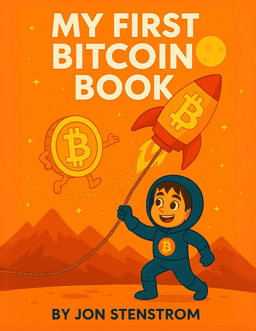
- If they want to know more: For a complete A-Z introduction, My First Bitcoin Book covers all 26 concepts with illustrations kids actually enjoy.
- If they want to understand how Bitcoin actually works: The what is Bitcoin explainer is written for their age group and picks up where this lesson leaves off.
Sources
- Consumer Financial Protection Bureau, Youth Financial Education Resources
- Federal Reserve Bank of St. Louis, M2 Money Supply (FRED Economic Data)
- Saylor, Michael. Bitcoin for Corporations keynote, discussing absolute scarcity
- National Endowment for Financial Education, Financial Education Research Projects
- Nakamoto, Satoshi. Bitcoin: A Peer-to-Peer Electronic Cash System (2008)
- Jump$tart Coalition for Personal Financial Literacy, National Standards in K-12 Personal Finance Education
This site is created by a Bitcoin advocate and parent. It presents one perspective on money and financial education. Nothing here is financial advice. Bitcoin is volatile and you can lose money. Consult a licensed financial advisor before making investment decisions for your family.
Keep reading
Teaching Kids About Saving vs. Spending
A hands-on lesson for teaching kids ages 6-9 the difference between saving and spending. Uses two jars, real coins, and a savings goal they pick themselves.
How to Teach Scarcity to Kids
A 15-minute hands-on activity that teaches kids ages 6-9 about scarcity using beans. Three rounds that build from simple buying to understanding inflation.
Bitcoin Lesson Plan for Middle School (Grades 6-8)
A free, classroom-ready 45-60 minute Bitcoin lesson plan for middle school teachers, with objectives, vocabulary, step-by-step flow, discussion questions, and an assessment.
Build the worldview your treasury needs
My First Bitcoin Book helps kids learn the words behind saving, scarcity, self-custody, and sats.