What Is a Bitcoin Wallet? Explained for Kids
Most parents (myself included) get confused at first. A Bitcoin “wallet” doesn't actually hold any bitcoin. The bitcoin lives on the blockchain. Your wallet holds the keys that prove you own it. I know. It took me a minute too.
A Bitcoin wallet is software (or a physical device) that stores the cryptographic keys you need to send and receive bitcoin. The bitcoin itself stays on the blockchain; your wallet just proves ownership. There are three main types: hot wallets (apps on your phone), cold wallets (offline hardware devices), and custodial wallets (a company holds your keys for you).1
What is a Bitcoin wallet in simple terms?
A Bitcoin wallet is like a special password that lets you send and receive bitcoin. Your bitcoin isn't “inside” the wallet, just like your money at the bank isn't inside your debit card. The wallet is how you access it.
Saylor describes Bitcoin as “digital property” and your wallet is the deed that proves it's yours.6 Unlike money held in a company account, self-custodied Bitcoin doesn't depend on an exchange or a bank. That cuts out the middleman. It also puts the keys squarely on you.
What are public keys and private keys?
Every wallet has two things: a public key and a private key. The public key is like your email address. Anyone can send bitcoin to it. The private key is like your password. Whoever has it can spend the bitcoin.1
If you lose your private key, the bitcoin is gone. Nobody can recover it. Not a bank, not a company, not the government. An estimated 3-4 million bitcoin are permanently lost this way.2 That's roughly 15-20% of all bitcoin that will ever exist.
This is the number one thing Bitcoin parents need to understand. Write down your keys. Store them safely. Treat them like the deed to your house. (For the step-by-step, see our wallet setup guide for kids.)
What are the types of Bitcoin wallets?
Hot wallets are apps on your phone or computer. They're connected to the internet, which makes them easy to use but slightly less secure. Good for small amounts you spend regularly. Think of it like cash in your pocket.
Cold wallets (hardware wallets) are small physical devices that store your keys offline. Trezor is a common option. Devices like this cost roughly $60-$150 and look like USB drives.3 Good for savings you don't touch often. Think of it like a safe deposit box.
Custodial wallets are when a company or app holds your keys for you. It's the easiest option, but you're trusting them. If they get hacked or go bankrupt, you might lose your bitcoin. The Bitcoin community says “not your keys, not your coins” for a reason.4
Kid questions about Bitcoin wallets
- “Can I have my own wallet?” Absolutely. You can set up a wallet on a phone in about 2 minutes. For kids, a custodial app with parental controls makes sense while they're learning. (See our guide to whether minors can own bitcoin for the legal details.)
- “What if I forget my password?” That's the scary part. With Bitcoin, there's no “forgot password” button. That's why we write down the recovery phrase (usually 12 or 24 words) and keep it somewhere safe.1
- “Can someone steal my bitcoin?” Only if they get your private key. That's why you never share it, never screenshot it, and never type it into a website someone sends you. For more on safety, read is Bitcoin safe for kids.
Try this at home
The key and lockbox game (10 minutes, ages 6+). Put a small treat in a box or envelope. Write a “secret code” on an index card. That code is the only way to open the box (you're the gatekeeper). Now give your kid the code. They can “spend” what's in the box by showing you the code. Ask: “What happens if you lose the card?” They can't get the treat. “What if you show the code to your brother?” He can take the treat. That's how private keys work.
Materials: A box or envelope, a treat, an index card. Time: 10 minutes.
Sources
- Bitcoin.org, Securing Your Wallet
- Chainalysis, Bitcoin Lost and Held Analysis (2021)
- Trezor, What is a hardware wallet?
- Antonopoulos, Andreas. Mastering Bitcoin, Chapter 4: Keys and Addresses (O'Reilly Media)
- Nakamoto, Satoshi. Bitcoin: A Peer-to-Peer Electronic Cash System (2008)
- Saylor, Michael. Interview with Anthony Pompliano, discussing Bitcoin as “digital property”
This site is created by a Bitcoin advocate and parent. It presents one perspective on money and financial education. Nothing here is financial advice. Bitcoin is volatile and you can lose money. Consult a licensed financial advisor before making investment decisions for your family.
Keep reading
What Is Bitcoin? Explained for Kids
A plain-English explanation of Bitcoin that you can read to your kids or use as a conversation starter at dinner.
What Are Satoshis? Explained for Kids
You don't need a whole bitcoin. Each one splits into 100 million satoshis. Here's how to explain sats to your kid, plus a calculator game they'll actually enjoy.
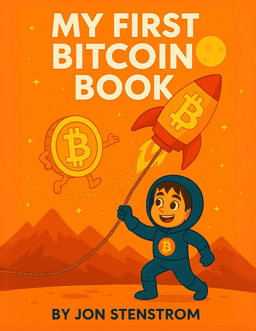
Give your kids the language behind your family treasury
My First Bitcoin Book introduces 26 Bitcoin concepts with fun illustrations, designed for ages 3-8.
Get the Book